• Skip to main content

Uncharted Veterinary Conference

Revolutionary veterinary marketing & business conference for those forging their own paths and telling their own stories.

  • Account
    • Log In/Out
  •  

Blog

Aug 14 2023

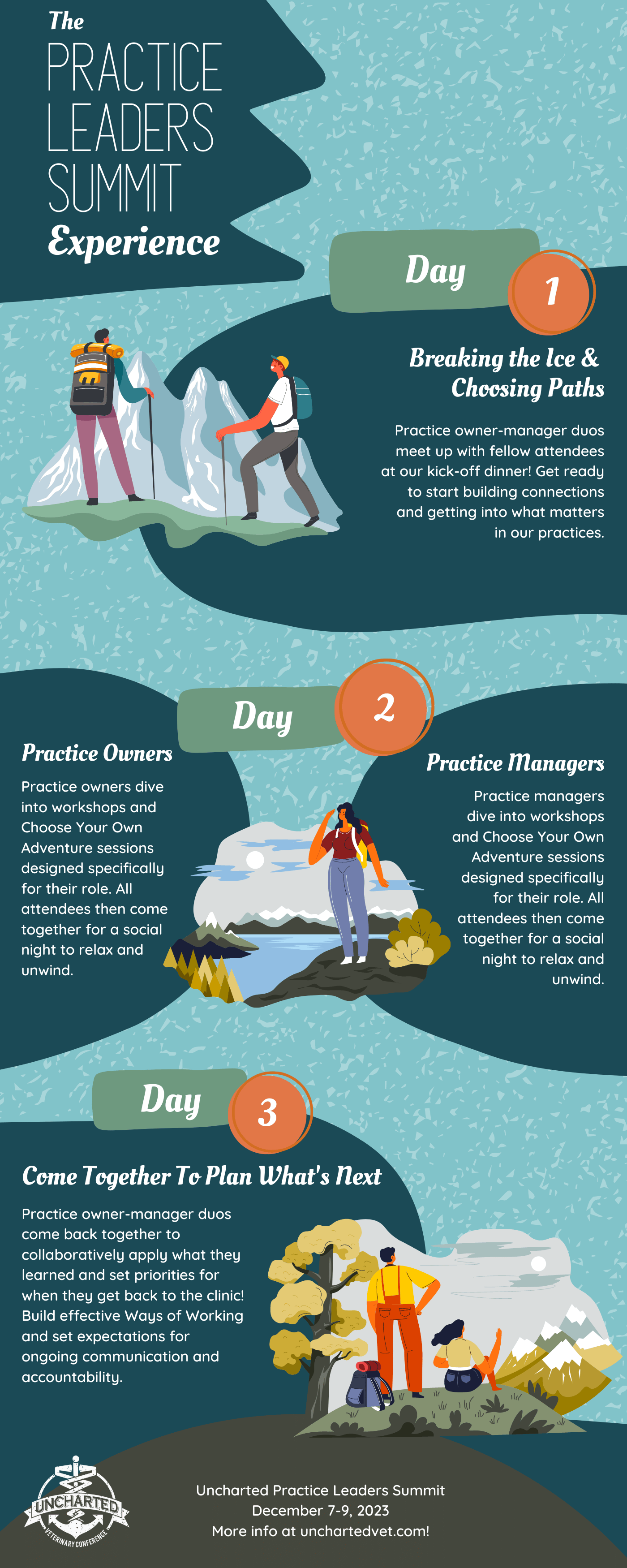
The Practice Leaders Summit Experience

With the right partner, magical things can happen. As veterinary practice leaders, owners and managers form a powerful partnership that sets the tone for a clinic's success. Their ability to work as a team requires collaboration, communication, and each person's effectiveness in their role.

The 2023 Uncharted Practice Leaders Summit provides a unique format to help these dynamic duos find the space to work together as partners and to focus on the specific challenges of their unique roles alongside a group of peers.

Day 1 – Break The Ice & Choose Paths

Practice owner-manager duos meet up with fellow attendees at our kick-off dinner! Get ready to start building connections and getting into what matters in our practices.

Day 2 – Focus On Role-Specific Challenges

Practice owners and practice managers split to dive into workshops and Choose Your Own Adventure sessions designed specifically for their role. All attendees then come together for a social night to relax and unwind.

Day 3 – Come Together To Plan What's Next

Practice owner-manager duos come back together to collaboratively apply what they learned and set priorities for when they get back to the clinic! Build effective Ways of Working and set expectations for ongoing communication and accountability.

If you're a practice leader looking to strengthen your partnerships within the veterinary clinic, this event may be just what you need! Learn more here.


Written by TylerG · Categorized: Blog

Aug 10 2023

Uncharted Culture Conference 2023 Speaker Feature

Culture can turn a practice into the place everyone in town wants to work, or break it down into the place no one wants to apply. At the Uncharted Culture Conference on October 11, 2023, we have an amazing lineup of speakers who have proven methods to improve clinic cultures. Get to know more about the speakers, their sessions and some ways they've given back to Uncharted!

General Session Speaker: Phil Richmond, DVM, CAPP, CCFP, CHC-BCS, CRTDR

Me, We, & Us: The Shared Responsibility of Psychological Safety

photo of Phil Richmond

We are very excited to announce our General Session speaker for the 2023 Uncharted Culture Conference – Dr. Phil Richmond! If you have met Phil Richmond or have had the opportunity to hear him speak, you understand his passion for the subject of organizational wellbeing. That passion is a big part of why we are going to kick off the Culture Conference with his new session – Me, We, & Us: The Shared Responsibility of Psychological Safety. Read on to learn more! Phil is a long-time active participant in the veterinary industry. He has been a practicing veterinarian in Florida and also heavily involved in initiatives toward improving wellbeing throughout the industry. His contributions to our Community have been numerous and generous, and he was awarded our Founders Award at the 2023 Uncharted Veterinary Conference in April. 

Why is psychological safety important?

Psychological safety is tightly related to team retention and avoiding burnout in veterinary medicine. Being comfortable sharing ideas and having human needs of belonging met in the workplace can directly influence someone to stay in their workplace. Dr. Richmond has studied and spoken on the subject of psychological safety at many industry events. You can learn more about the subject and his work at his website.

Who is responsible for psychological safety in businesses and organizations? The answer is me, we, and us. In this session, Phil will share the “me, we, and us” framework from leading organizational wellbeing research in a way that any person in a veterinary practice or business can understand. The framework covers individual wellbeing (me), developing high-quality relationships (we), and the organization’s role as whole in preventing burnout (us). You will walk away with facts that will support getting buy-in and ideas on how exactly to implement the concepts!


Workshop Speakers

You will be able to attend one of these amazing workshops LIVE and will have access to the recordings of the others 1-2 weeks after the event is over!

Maria Pirita, CVPM

The Accountability Ecosystem: Cultivate a Culture for Success

photo of Maria Pirita, CVPM

Where is the balance between setting goals and clear expectations and micromanaging? Creating a system of accountability may sound intimidating, especially if you’re starting from scratch. Maria Pirita is a CVPM and one of the most understanding and kind people we know. If anyone can help you start a new and possibly daunting task like this, it is her! In her 2-hour session, she will walk you through a 3 part ecosystem of accountability and the tools to implement it at your practice that doesn’t leave the responsibility on one person alone! Walk away with an action plan to get started and working documents that you can adjust as you move through the process. Plus, you can bet that she will be ready to answer questions…and very excited to learn more about you! 


Senani Ratnayake, BSc, RVT

Owning Our Success – Five Steps to a Culture of Accountability

photo of Senani Ratnayake

When determining a plan for how your practice will set expectations around ownership, responsibility and accountability, tough conversations with your team are unavoidable. How do you work through those conversations with empathy and understanding? Senani Ratnayake has a way with words, and is just the person to help guide you through making tough conversations effective, clear, and compassionate. In her workshop, Senani will share how to define and reframe the concept of accountability with your team, how to discuss the significance of intention versus outcome and impact, and help determine how you will measure accountability with your team. Leading by example will be a big part of your success, so take this opportunity to ask Senani your questions and learn how to guide your team toward a stronger culture! 


Mark Nunez, DVM

LEAN Principles in Practice

photo of mark Nunez

Processes in practice sometimes don’t work as well as we believe they do, and the best people to share that with leaders are the people working within them! Dr. Mark Nunez has been an advocate for LEAN boards as a decision-making tool since we met him at his first Uncharted event! He has seen the effects of giving his teams a voice in making changes in veterinary practice, and it has led to ongoing support for this concept. This popular 2-hour workshop will provide you with a system that taps into your entire team’s perspective and builds on a culture that values team members that share their ideas to make the entire practice the best it can be!


Rebecca May

How a No Blame Culture Approach Can Safeguard Against Medical Errors

photo of Rebecca May

Making a medical error is any veterinary professional’s greatest fear. Addressing these moments with individual accountability alone can damage trust and lead engaged team players to disengage and even leave. For Rebecca May, her years of experience in veterinary medicine and role as a practice manager of an emergency clinic in North Carolina highlighted exactly that. A “No Blame” approach guides leaders to address individual and systemic contributions to medical incidents and mistakes that inevitably happen in veterinary medicine. Looking at the whole picture, monitoring for trends and changing the narrative of blaming could be a singularly effective tool to improve your practice culture. Rebecca May’s Incident Decision Tree will help your team stop avoiding discussing mistakes and invite them to be part of making systems that really work.


Written by TylerG · Categorized: Blog

Aug 09 2023

Discounting for Friends and Family – Will It Piss the Team Off?

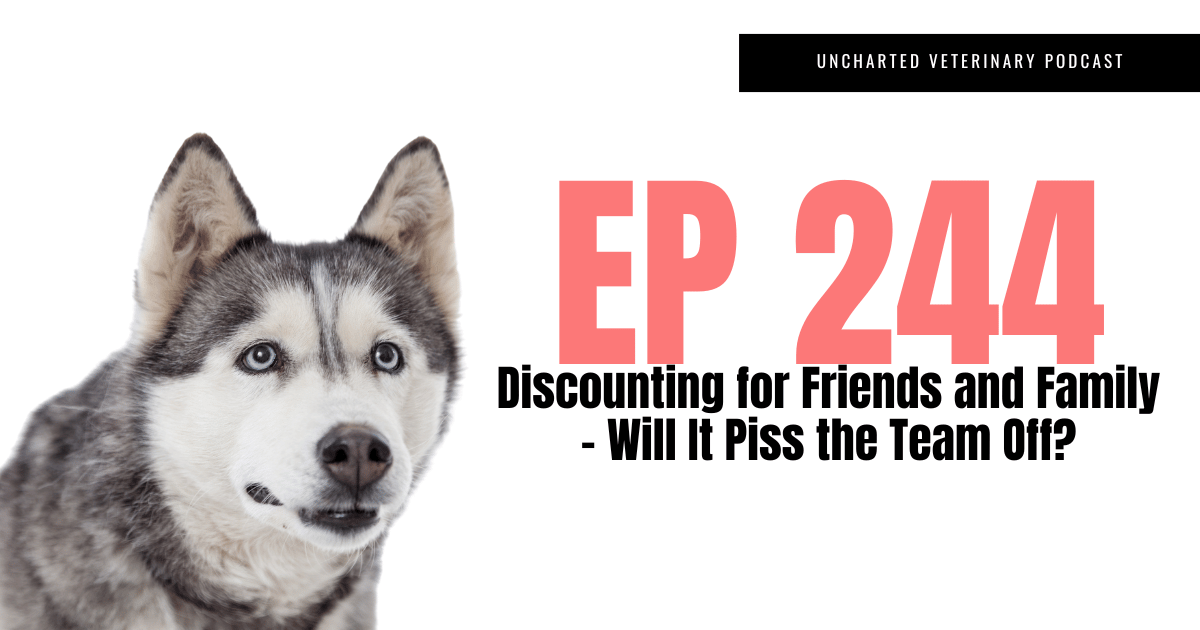
Uncharted Veterinary Podcast Episode 244 Cover Image

This week on the podcast…

This week on the Uncharted Podcast, Dr. Andy Roark and practice management geek Stephanie Goss dive into a mailbag question from a new practice owner who is thinking ahead! They want to take care of their team and set up great employee discounts. And they want to help take care of the pets belonging to their friends and family who helped get them to where their dream of practice ownership is finally a reality. How does that mix with their plans for their team? We'll find out – Let's get into this…

Uncharted Veterinary Podcast · UVP – 244 – Discounting For Friends And Family – Will It Piss The Team Off?

You can also listen to the episode on Apple Podcasts, Spotify, Google Podcasts, Amazon Music or wherever you get your podcasts.

Do you have something that you would love Andy and Stephanie to role play on the podcast – a situation where you would love some examples of what someone else would say and how they would say it? If so, send us a message through the mailbag! We want to hear your challenges and would love to feature your scenario on the podcast. Head over to the mailbag and submit it here

Submit your questions here: unchartedvet.com/mailbag


Upcoming Events

All Upcoming Events


Episode Transcript

Stephanie Goss:
How many times have you called a client in the last three days, left a voicemail, and then had somebody call back and say, “I had a missed call from you,” not even having listened to the voicemail. Look, the data shows clients want texting. They want online and digital communication. So if your practice does not offer texting two-way with your clients, you are missing out in a big way. And you're also in luck because our friends at Simple Texting have done the research, that one in three clients check their text notifications within a minute of receiving a text, one in three. And that goes up to 85% of all of our clients within the first five minutes after receiving a text. So if you're listening to this and your practice isn't yet texting two-way with your clients, you are missing out in a big way.
And I don't want you to miss out anymore, and neither does Andy. So our friends at Simple Texting have put together a deal for you, our Uncharted listeners. That's right. They have got texting plans that you can try for free for 14 days, but if you go to simpletexting.com/uncharted, they are going to give you up to $100 worth of free credits when you sign up for texting for your clinic. There is no reason, none whatsoever today to not be texting with your clients. So if this is you, head over to simpletexting.com/uncharted, get your deal, check out all of the amazing options.
Hey everybody, I am Stephanie Goss, and this is another episode of the Uncharted Podcast. This week on the podcast, Andy and I are diving back in the mailbag. We got a great letter from an ambitious startup owner who doesn't want to break the bank or employee relationships. They're asking some questions about discounting for their team while also taking care of the friends and family who help support them and get them to the place where their dream is becoming a reality as a new practice owner. This was a really fun episode for Andy and I to talk through. We hope you enjoy it. Let's get into this.

Audio recording:
And now, the Uncharted Podcast.

Andy Roark:
And we are back. It's me, Dr. Andy Roark, and the one and only Stephanie, I've got friends in low places, Goss.

Stephanie Goss:
Now sing it for me please.

Andy Roark:
I've got friends in low places.

Stephanie Goss:
You are no Garth, my friend.

Andy Roark:
No, I know. I have never claimed that I could sing. I can't carry a tune in a bucket.

Stephanie Goss:
But I appreciate that attempt.

Andy Roark:
It's bad.

Stephanie Goss:
I appreciate that attempt. How is it going, Andy Roark?

Andy Roark:
Oh, it's good. It's really good. Things are rolling along here. I'm hanging out here petting my doodle with a self-confidence problem. I was doing…

Stephanie Goss:
Stop it.

Andy Roark:
No. It's worse. It's worse. I was doing my other podcast, Cone of Shame, with the vet behaviorist, Lisa Radosta, who is amazing. She's amazing. And I should have just hit record. I think I'll probably go back. I think I'll probably get her back on. I did that thing where like, “Oh hey, while you're here, I got this dog.”

Stephanie Goss:
You were that client.

Andy Roark:
I got this dog. I was. I was like, “Hey, will you come do a podcast while you're here? Look, can you look at this?” I was like, “I got this dog and he piddles on the floor. If I come home and go to pet him or greet him, every now and then, he will pee on the floor and he's four years old.” And she started talking to me about urination like that and asking me about, “How does he look? What does he do with his ears? What does he do with his head,” all these sorts of things. And she was like, “Yeah, this is a conflict sort of response. And so he's got anxiety around meeting people or people reaching out and petting him and things like that,” and I was like, “Okay, well, what do we do about it?” And she's like, “Well, he has low confidence, Andy. You have to get his confidence up.” So now, I reported all of this dutifully and now I'll be like, “He's a bad dog.” And my wife is like, “You're going to hurt his confidence. Don't.”

Stephanie Goss:
Wait, wait, wait, wait, wait, wait, wait. Let me get this straight. So not only do you have a doodle.

Andy Roark:
I have a doodle with confidence issues. That's what I have. That moment of silence was just Stephanie just shaking.

Stephanie Goss:
I'm dying. This is priceless.

Andy Roark:
Now I sit with him, we do affirmations. I'm like, “You're a good boy, you're a handsome boy, you're a smart boy.”

Stephanie Goss:
Boosting his confidence.

Andy Roark:
People like you.

Stephanie Goss:
Oh.

Andy Roark:
So yeah, I'm working on Skipper Roark's confidence.

Stephanie Goss:
Okay, Skipper, Skipper. I can't even say anything with a straight face. Skipper has got confidence issues. The only thing that Skipper is confident about is his ability to go pee in the neighbor's yard, right where the sign says, “Don't pee on my lawn.”

Andy Roark:
Yeah. He's confident that he wants to poop in the no pooping yard. He's very confident about that, but no, the whole time, I thought he was bad. It turns out he is just insecure. It's a lot like…

Stephanie Goss:
He's also bad because let's be clear.

Andy Roark:
Yeah. Well, it's like the high school boy where people are like, “Oh, that guy is a jerk.” It's like, “No, he's just got self-confidence issues.” And that's Skipper. He 100% went into my wife's purse and chewed up her migraine medicine.

Stephanie Goss:
Oh, no.

Andy Roark:
And she was like, “Why would he do that?” I was like, “Leave him alone. He's got confidence problems.” All right. That's enough. That's enough. We should respect his privacy. Yeah. We should respect his privacy and move on.

Stephanie Goss:
Bad dog. Okay. Fair. Well, I'm excited. We've got a question from the mailbag today. And I was thinking back and I don't think we've actually tackled anything like this topic before, so I'm kind of excited about this. We've got a letter from a new practice owner and they are getting ready to open their practice here at any moment now, which is just big congratulations right off the bat because that's awesome. And they said, “Well, I have a question about discounting,” which I love that they're asking questions before they start doing things.

Andy Roark:
That's super smart. Because once you start, you're in it.

Stephanie Goss:
Exactly.

Andy Roark:
Once you start doing anything with your family, it's hard to be like, “Yeah, I'm not doing that for you anymore.” That is challenging. All right. So go ahead.

Stephanie Goss:
Yes. So they were like, “I want to set up a discount that takes care of my team because I care about them and I want to take care of them. And my friends and my family have really supported me through this whole endeavor. They supported me through school and being in practice. Now, I'm opening my own practice and my love language is gifts and acts of service. And so for me, the ultimate would be to pay back my friends and family and take care of them and take care of their pets as a thank you. My parents, my in-laws, I want to say thank you for supporting me on this journey and take care of their pets.” And so they're a kind and generous person. And so they're just like, “I want to do that.”
And they're thinking with a business head and they're like, “If I take a step back, I want to make sure that I'm maintaining fairness and avoiding creating disparities within the clinic because I don't want to give things away to my friends or my family for free that I'm not willing to give to my team and I need to make this a fair situation.”
And so they were like, “How can I approach the idea of friends and family discounts without compromising the fairness and integrity to my team and the discounts that they're going to get and the clinic policies that ultimately I'm going to set.” And was signed from an ambitious owner who does not want to break the bank or employee relations, which I absolutely love. And so I need us to start with giving this practice owner or this new practice owner big giant kudos for asking the questions because they are great.

Andy Roark:
It's always good to try to figure it out before you get into the moment, before you make it a pattern. Right? A lot of times with practice ownership, we have to figure out, we have to get there before we can start to make policies. I see a lot of people who spend a lot of time making policies for things that will never happen or they'll make big plans about what will happen if this thing, and then it never comes together. But anyway, in this case, knowing that we have friends and family who are around, I think it's good to think this through so you're not just making it up on the fly.

Stephanie Goss:
Yeah. Totally.

Andy Roark:
I have thoughts. The frustrating answer to this question, it's very, very simple. It depends. It wildly depends. Thanks for tuning in everybody. That's our episode. No, it wildly depends. It depends on how does your staff feel about their compensation package, right? Are they struggling to pay for services? Because if they're struggling to pay for services and you're no charging your friends, if they struggle to pay for services for their own pet, or if they're living hand to mouth and they feel like, “Oh man, this is hard to make ends meet,” and then you are giving stuff away to your buddies, they're not going to feel good about that. Or do they feel okay, or do they feel like, “Okay, I understand they're family. I would want to treat my family like that and gives the family the staff discount. I'm okay with that.” A lot of it depends. It depends on how many people are we talking here? Friends and family, what is that, one person a day? Is that one person a week? Is that one person a month? What is that?
I've seen practices. We've gotten letters. You and I have gotten letters from practices where there's an extended family and they're just rolling in all day long, going in and out and getting what they want. And so, how many people are we talking about here? Is this a revolving door of people getting discounts and breaks or is it your two best friends and your brother? Okay. Those are just different things. How do your friends and family act when they come in? How do they treat the staff? We've gotten letters about that where the family rolls in like they own the place. Basically, they don't have appointments. They walk in whenever they want. They don't listen to the texts. They dismiss them. They walk right back into the treatment room with their pet and just the staff feels wholly disrespected by these people who are coming in. And just, man, that's toxic. That's really toxic.
And I totally, I empathize with those letters when we got them. It's like, “Oh man, that's not okay.” And so all of those things really, really matter as far as, what are we talking about here? And again, I don't think anybody would think too much if you have a couple of people who come in every now and then and they're your family or close friends and you take care of those people. It's probably not a big deal, but I've 100% seen it become a big deal. It really depends on how you're doing it. And like I said, it depends a lot on how the staff feels, how they get treated, things like that. All that stuff matters. And the last part is, fair is where pigs win ribbons, there is no… What?

Stephanie Goss:
Oh my gosh. I'd never heard that. And that is the most southern thing that I've heard you say in so long.

Andy Roark:
You haven't heard that? Oh, fair is where pigs win ribbons. It is. So here's the thing, right? If I took a big group of people and I said to them, “Is the electoral college a fair way to do elections?” They would not agree.

Stephanie Goss:
Right.

Andy Roark:
And you would never convince all of them yes or no, but they would never agree. I was just trying to pick a thing that in our country, some people are like, “Nope, not fair.” And some people are like, “It is the most fair way.” And there's not a right answer. I don't know. Is it fair or not? It depends on who you are. It depends on what you're trying to do. It's the point of debate, but that's the whole point.
And so some people would say, “Sure, it's fair that this person's family doesn't have to pay for services or gets a big discount.” And other people would say, “It's not fair when we don't get the salaries that we need because this person's giving things away.” And again, people just depending on their worldview, you can have the same team and they could be split down the middle about what's fair and what's not. There's not a, “This is fair. Everyone's going to see it. They're all going to agree that it's fair.” And that will be the decided upon state of being is yes, fairness.

Stephanie Goss:
Yeah, because fairness is subjective. Right? And so, I think there's two pieces. You're spot on. The fairness is subjective and what one person views as fair may not be viewed the same way as another person in the situation or outside of the situation. So we're totally looking at fairness through the lenses of our own lives and our own experience. So that's number one. And so if fairness is super, super subjective, then there's two other pieces from a head space perspective that are really important for me. Number one is clear is kind. And so fairness is going to be subjective. And so the only way out of this that is positive all around as a practice owner for the team, for friends and family, is to make sure that you are very clear because that is going to be the most kind to everybody. So everybody knows what's happening, everything gets communicated very clearly. Clarity is your friend here.
And the third piece of it that I think is really, really important is that recognizing that what you do today and how you are clear and equity that you put into place today is going to change, may change as you go. Because you are about to open your practice and what works today about to open your practice may be something completely different that works for you six months from now, six years from now. Your practice is going to grow and change and evolve. And so the other piece of head space is don't think about this. I'm going to set a policy for my hospital that is going to be the policy on discounting until the end of time. That's the wrong way to look at it, in my opinion. Think about it as what am I going to do right now and for the foreseeable future, and when am I going to reevaluate? Because that will help you with that clarity for yourself and for your team.

Andy Roark:
I like that. I would also say, it's much easier to loosen up later on than it is to tighten it back down. And so I think that if I would start with a conservative policy, especially as you open. You're like, “We just opened up.” You know what I mean? I'll say something that may come off as… I don't know, it may be contrary or whatever, but I'm not particularly excited about having my friends as clients. And there's a lot of people who just would disagree with me. And you hear that and go, “Oh my God.” But the truth is, I like to be a vet, and then I like my friends to be my friends. If somebody would not come to me as a veterinarian if they didn't get a discount, then I don't really want them to come to me as a veterinarian anyway.
And I don't really personally, I'll just say, I've been doing this for a good amount of time now, I don't really like the veterinarian relationship woven into my friendship relationship. I don't like when I'm suddenly the service provider to my friend who's unhappy with something. You know what I mean? There's an awkwardness there that I don't really like.
And I guess it's one thing if you need the money or you're trying to get something up and going and things like that, and your friends can be your best clients. They can be. They can also be your worst clients and they can also make friend gatherings awkward when you're like, “Yeah, and I heard that medial patella luxation surgery didn't go the way I wanted. And I know that every time you see me, you think about it.” That's odd. There's just a little bit of awkwardness there too.
I'm not saying that other people, you shouldn't do vet work for your friends. I'm not saying that. But I am saying, I don't race out and say to people, “You should come and see me.” In fact, I generally don't. I generally don't. I like to keep my friends and my business separate as much as I can, but that's just kind of always how I've sort of done it. I'm happy with my neighbors to come and see me, that's fine, but that's the level of relationship that we have. And so anyway, I'm not trying to set a rule here or anything at all. And maybe no one else feels that way, but I do.

Stephanie Goss:
No, I think that it's good that you bring it up because I think that it is regardless there's going to need to be some boundaries, right? And I think I'm glad that you brought it up because most of the time, you and I see the opposite end of the spectrum. What you were talking about where there isn't as many boundaries and where the rules are not the same for friends or family as they are for the team and other clients. And that's where it gets people into trouble. And so thinking about it on the spot here as we're talking about this, every single practice that I have ever worked in, there has been a friend or family member. There is someone who gets the discounts, but who is not our client. They don't follow the rules, they don't do any of the things that we make everybody else do. They are the exemption. And in every single situation, boy, did it piss people off, the team-

Andy Roark:
The staff gets really upset.

Stephanie Goss:
Yeah. And because whether it was they could just come in and take meds off the shelf like you were saying, or they didn't ever follow any of the rules. I remember vividly getting into it with the team because we had a rule in our clinic about, we wouldn't see patients and do procedures on patients that didn't have a current rabies vaccination, unless there was a valid medical reason. And yet, we had that one best friend of the practice owner who was just like, “I don't want my old dog to get vaccines.” And it was like, “Oh, they don't need to get it.” And the team was like, “Well, we would make any other client get a rabies vaccine if they were going to have a dental, but we're not going to make them.” And so I do think that it is important to recognize that as a whole. It tends to go in the negative direction a lot more than it does in the positive direction. And so I think-

Andy Roark:
I don't know. I don't know. I'm going to push back on you here. I don't know. I don't know if it really does because here's the thing, everybody remembers that client you were just talking about. You know what I mean?

Stephanie Goss:
Sure. Yeah, yeah.

Andy Roark:
But there may have been seven other clients that were friends and they just come in, they're respectful, they're nice. No one really pays that much attention. You know what I mean? They just get their little discount. They thank the front desk and they walk out and no one thinks twice about it. But it's that one and everybody remembers it. But that was sort of my point about, it really depends is because you could have a bunch of friends and family, and they're respectful, and they're blah, blah blah, and the staff is fine with this. Or you could have one and that person walks in the back and takes meds off the shelf and things like that, and they're like, “This is a nightmare.” Really, it's that big of variation.
And so it's really hard to set. It's really hard to set any sort of rule. I would never be like, “You can have five people.” It depends on the five people and how they behave and how the staff feels and all those things. But anyway, to your point, it's about, does it always go that bad? I don't know. Or do we just remember the ones that went bad and do they really stand out? I don't know. I don't know.

Stephanie Goss:
That's fair. That's fair. Because you're right in that for each one of those bads, I can think about goods in those same practice who were the regular clients who followed the rules, and they got their 5% off and it was totally fine. So I think that's a super fair point. And I think where I was trying to go with it was that there is the potential for that to be what the team remembers, is that one client because that does stick out really easily in our head. Right? And so I think from the practice owner's perspective, when you think about head space and getting into a head space to tackle what are you going to do and how are you going to do it, remembering that clear is kind and that fairness is going to be subjective.
And that your team, you are going to have to have the conversation and you might have the conversation today, you might have it six months from now, but what you decide today may not be the same. And I would agree with you, especially when it comes to friends and family, because friends and family is where just I feel like as humans, a lot of us struggle with boundaries more than anything, but it's pretty easy to have boundaries with a total stranger for the most part. This is our policy, take it or leave it. It's a lot harder to have those same boundaries with friends and family.
And so if you start wide and say, “I love you, thank you so much for making this happen. Come in. I'm not going to charge you for any of this care that your pet is going to need today,” if you start down that path, it is a lot harder to take that away and be like, “Oh, well, now the clinic's making money and so now I'm going to have to charge you.” That is a hard path to walk. So I think your point there is super important to think beyond just today and think about that long-term perspective and know that you can always give them an extra something down the road, but it's really hard to take it away once you've gotten something started.

Andy Roark:
This is not about friends and family. This is just my thoughts on discounting in general. And I talk about this all the time. I believe in intentional discounting, meaning not just willy-nilly giving stuff away. That is the path to ruin. I see it all the time. Just the person walks in, you're like, “I don't charge them for that” or “Let's just take that offer. I don't know. They already paid for a bunch of stuff, let's just not charge them for this.” That kind of willy-nilly, however, I feel discounting is that is bad, is bad for the business.
Here's the other thing too. The research shows that it doesn't make you happy when you just willy-nilly give things away. If you decide these are the people that I'm going to help or this is how I'm going to help, these are the mechanisms I'm going to help, this is a program we're going to place, the research says, you'll be more proud of that. You will know that you were doing it. You will be able to look back and you're like, “How did I help people?” And you will know, “I did this thing, I had this program, I gave this time,” whatever, but you intentionally decided, “I was going to help these people.”
And you know that your money, or your time, or your services or whatever are going through something that you decided was good to do. And so you can intentionally discount. You can budget that. Everything feels more in control. The staff understands why we're doing what we're doing. All of those things are important. So there's intentional discounting, but I would even step back further than that. And so my first thought here is, let's just do a quick, just a real quick truthfulness check. When we say, I want to do this because my love language is gifts, are we doing this because you have decided that these are people you want to give back to? Or are we doing this because you think that people will like you if you give them free stuff? Are you doing this because your value as a person is influenced by your generosity to your friends and family?
And again, I don't know this person at all, but I have seen a lot of people who were making choices about discounting because they want to be popular or because they didn't want to make anybody upset or they wanted to get along. And so my real thought is, again, I don't think that much about family, but friends and stuff. And so I go, okay, the first part of intentional discounting is, why do I want to support this person, and just decide. And again, I'm not saying right or wrong or anything, but it should not be this person smiles when I see them, and so I'm going to not charge them what I charge other people who I don't know. That doesn't make any sense. That's not fair. It's not fair and it doesn't really help anybody in a significant way or anything like that. And so I would start with, why are we doing this? And then I would move on into sort of more specific to what the program looks like.

Stephanie Goss:
And I think I'm glad that you said that because from the letter that we got, I don't get that that is the sense of where this person is at. They had clear examples of like, “My in-laws and my parents or the people who really supported me on this journey.” And so I can clearly see they do care and it is an act of service and a love language to gift them. You've supported me and now I want to pay you back and take care of your pets. So you can totally see that. And to your point, I can also see that same person struggling down the road with like, “Oh, well this is somebody that I care about now. Do I give them the same discount?” The same situation is not in play. I didn't just open my practice. Now I've been open for a year and a half, but this person, now I have a new sister-in-law, now I have new brother-in-law. Am I just going to extend them the same discount because they're my in-laws? And my other in-laws got this discount when we first started. And so now I'm going to…
I'm glad that you said that because I do think that from that big picture perspective, taking the step back and looking at, why are you doing it, who are you trying to serve, and why are you trying to serve them is really, is a good, clear head space to start because I think that there will be questions at some point down the road whether it comes from yourself, whether the questions come from your team, or whether it comes from friends and family who are maybe hitting you up for a discount. I've absolutely had people be… But I'm like, “Don't your friends get a discount?” No, I have to answer that question as a team member or as a practice owner. And so that may not be the situation today, but at some point in the future, that will be a question that you come up against. And so figuring out why you're doing what you're doing is a really important piece of the head space. So I'm glad you said that.

Andy Roark:
Yeah. That's important to me, is just to get my head around, “What are we doing here?” As opposed to just, “I'm giving money away because it feels good.”

Stephanie Goss:
Totally. Anything else for you from a head space perspective?

Andy Roark:
Well, one more thing. I was going to put in the action stuff, but I'll put it here as well. And this goes back to about my friends as clients and stuff like that. I just tell you, this is just personal head space from me. I'm not going to tell anybody else how to think about it or whatever, but I personally like to separate myself from my job. I go in and I do the vet stuff and I like it, but I want to be Andy when I'm not at the vet clinic and not Dr. Andy, just Andy. And so I do think a lot about that.
The last thing that I would say here is if you see what I'm saying and you're like, “You know what? I also have some concerns about kind of weaving my practice life into my personal life.” And again, this is different from your family because you want to help your family out and I get it. You can give and be generous in different ways. Just because you're a veterinarian and you own a practice, that does not mean that's how you have to give to your friends. It just doesn't. There's other things that you can give in other ways.
And so does it make you a lesser person if you charge someone full price at your vet clinic, and then come and help them move a couch up their stairs when they need it? I don't know that it does. You know what I mean? Is it if you host the neighborhood Christmas party, do you need to give everyone in the neighborhood a discount at your vet clinic? You know what I mean? It's not the same. And so when you start thinking about head space, I would say, just don't fall in the trap of, I am a veterinarian or I own a vet clinic and so gifts from me must necessitate professional services. You can give professional services away to no one and also be a very generous person.

Stephanie Goss:
Right. Yep. I love that so, so much. I'm glad that you said that.

Andy Roark:
Cool. Let's take a little break and we'll come back and try to get into some action steps here, how we set this up.

Stephanie Goss:
Okay.
Did you know that we offer workshops for our uncharted members and for our non-members? So if you're listening to today's podcast and you are not a member of Uncharted yet, you should be, but this is not a conversation about joining Uncharted. This is a conversation about all of the amazing content that we have coming at all of you, whether or not you're a member through our workshop series. You should head over to the website at unchartedvet.com/events and check out what is coming. We have got an amazing lineup on the regular. We've got something every month, sometimes two or three things in a month coming at you to expand your brain, to talk about leadership, to talk about practice management, and dive into the kind of topics that Andy and I talk about on the podcast every week.
So now's your chance, stop what you're doing, pick up your cell phone, I know it's not far from you, and type in unchartedvet.com/events. See what's coming and sign up. They are always free to our uncharted members and they have a small fee attached to them if you are not currently a member. You can get all of the details, pricing, dates, times, and register. Head over to the website now. I want to see you there.

Andy Roark:
All right. So I think for action steps, I think we should start with intentional action, figure out what you're going to do. Again, here's where I'm going to throw a wrench into the work for a lot of people and say, “I'm still, I'm going to beat this drum.” I'm not convinced that you have to have a program at your practice where people come in and they just get a discount. I think you should think about who you're trying to help and how you're trying to help them. I would be personally, again, it depends on how big your family is, what you're trying to do, things like that. I would be much more open to the idea of trying to figure out how to do, I don't know, a separate program to help out my friends and family.
Maybe I take one Saturday every couple of months and say, “Guys, I'm doing vaccines over at the house. If you guys want to come over on Saturday, I've got the cloud pin software pulled up, but I'll bring you guys in. I'll do this. I won't have any of my technicians there or I'll have one technician there and pay them or whatever, but I'll bring everybody over. I'll do this little program, blah, blah, blah.” But it's not people coming into the practice, going through our process, taking up tech time, things like that. I'm just saying, “No, this is a little thing that I can do that is separate and I can intentionally do it. And it does not distract from the work of others. It's not putting my friends onto my staff in a way that makes their jobs harder, their lives harder,” things like that.
I think honestly, I'll tell you this. I think you're being really generous if you have an open door policy where your friends can call you and ask you about their pets. I personally don't like that and that's why I don't want my friends as my clients. Again, I'm not trying to be a real curmudgeon about it, but I got kids and I like to go home and I like to be off, and I don't really like people calling me and shaking me down for vet advice or things like that. And of course, I'll help you if you call me, but I'd really prefer that I not get a bunch of calls. And as your friend network expands, you can get a lot of people doing that. And so I personally just like to have some boundaries about when I'm available, when I'm not.
But I mean, I would say the idea that you take someone's phone calls after hours, you invite them to bring their pet by your house so you can have a look, you set up a little gathering to do vaccines or wellness care or things like that for your family or your friends, you do things like that, but then you don't give them a discount whenever they walk into the vet clinic or let them come in with no appointments or things like that. And that makes you not a generous person. I go, “I don't buy that for a second.” And so anyway, it goes back to being intentional. I'm not trying to be stingy about it at all, but I really do think that you can be very generous with people and not have a discount at your vet clinic. I do believe that.

Stephanie Goss:
Yeah. I think for me, from figuring out what to do, what I will say is I think after my feelings around discounting and what do we do for our teams and for friends and family have changed up, down, backwards, sideways over the years because I've done it a bunch of different ways and I've experienced it different ways in different practices. And the why being different in different places. And so I think for me then, this is purely personal, figuring it out meant deciding why I was doing it and what I was trying to get out of it.
And the most clear head space that I have ever been able to get into as a leader and as a practice owner would be to say, “I want the experience for my team.” And this for me, holds true for friends and family, to be the same experience that I would provide for any other client because the why for me is that I want our practice to be a place that any member of my team, any member of my friend group or family wouldn't hesitate to recommend to anybody that they meet to bring their pet into my practice.
And so for me, if that's my why, then it makes it a lot more clear on how I am going to deliver that. Because if I want my team to experience the same level of service that clients experience, that does not mean that their pets get stuck in a cage until the end of the day and dealt with after everybody else goes home. It does not mean that they get the short end of the stick. It doesn't mean a lot of things that we can see happen in practice when it comes to taking care of staff pets.
And the same goes for clients. Totally, I like your idea, Andy, and the outside the box thinking of, well, maybe you do a special thing for them and you figure out what that looks like. And I could totally see that. And at the same time, if my why… For me, my why was about, I want them to experience, I want them to come in. I want them to hear the same spiels from my team. I want them to build the relationships with the team. I want them to have that same kind of white glove experience that I personally cultivated in my practice. And this is totally me speaking from my personal experience here. So not going to be the right fit for everybody.
So for me, I would have a hard time with that because I wouldn't want to… It's funny talking about this. Patty's going to kill me. So when I started working in VetMed, it was a million years ago and we were just kind of transitioning. I grew up with pets that lived in the backyard. They didn't come in the house. And when I started working in VetMed, we had just transitioned and I remember vividly to having our first dog that kind of lived in the house. And God, we love Mercy. She was the best dog. But my parents were not my ideal client now, my parents were far from that ideal client.
It was the bare minimum. They didn't get dentals. We didn't do a lot of the things. And that was because the medicine has changed, but also, because of how we related to our pets has changed significantly. And when I think about about the care that I provided in the beginning for my own pets, it was not the same care that I was recommending in the practice. It was like, well, I know what the bare minimum is, and so I'm just going to do the bare minimum for your pets because that's how you have always treated them. And I think I deprived myself and my family the opportunity to learn and grow and believe in the things that I truly did believe in the practice. And so I think for a lot of us, there is the potential to have that discrepancy there.
And so I think for me, that's a big part of the figuring out what that why is and what you're going to do, because I think it will help you figure out how do you then action plan it. And so for me, I wanted my parents ultimately to experience it. And so I started forcing my mom. I'm like, “Nope, you have to call the clinic and you can talk to me as the CSR upfront, but you have to call the clinic and make an appointment. I'm not going to make an appointment for you. I want you to fill out the survey when you leave. I'm not going to tech your appointment. Somebody else is going to go in there because I want to get the feedback. I want to know how are we doing? How did we stand up to what… I want you to experience it like any other client.” That became a motivator for me as a leader with my own family, but also with my team.
And so figuring that out really, really helped me to have clarity and that ability to see clearly with figuring out, what is my protocol? What is my policy? How am I going to approach this? And really not have it just be willy-nilly. Or I don't know, this is what I decided at two o'clock in the morning and I wrote it down. So that's what we're going to do, which is when we're starting up a practice, that's where a lot of us start from. And so I think, for me, what is right for me is not necessarily what's going to be right for you, Andy, as Dr. Andy, or what's going to be right for our friends who owns the practice down the street. But whatever is the driver, figuring out the why behind that will help you figure out then the what are you going to do with it.

Andy Roark:
Yeah, I know. I agree with that. It's funny. We've talked about kind of blowing off staff pets before when they bring them in. Look, talk is cheap and people watch what you do. And so if you have your friend come in and you're just like, “Hey, come on in. Let me just do these vaccines for you real quick. All right. You're all set. All right, take care, buddy.” That sends one of two messages, right? It either sends a message that you don't really care about your friend's dog because you just popped him with vaccines and sent them out, or that all the hand waving you do about how important your exam is, is bullshit. Because when it's your friend, you just pop them with vaccines and send them out the door and whether they're like that-

Stephanie Goss:
But when it's the team… Yep.

Andy Roark:
Because that's what they need. You know what I mean? And so you can choose either of those two beliefs. You either don't care about your friend's dog or you don't care about all the other dogs because really, just doing what you need for your friend's dog and everybody else is getting a bunch of hand waving. You know what I mean? And so the staff is always watching. They're always watching. And again, I want to keep this in proportion where it's not like if you bring your friend Dave's dog in one time and do this, everything you've worked with your staff goes out the window. Of course, it doesn't. It's all a matter of proportionality and those sorts of things. So again, I don't want to over-generalize and say, if you do this one time or you behave this way once, your whole credibility is destroyed, but it does take a toll. And so it's just a lot of that.
So anyway, I think sort of to summarize the takeaways for me with the friends and family discount is be intentional on why you're doing this and that will help you sort of figure out who you're doing it for. Consider doing things that are not just inside your vet clinic, whether it's things that don't have anything to do with vet medicine or whether you set it up and say, “You know what? I do this with my neighbors.” If they'll text me or they'll see me and they'll say, “I'm really worried about my dog.” And I'll say, “Bring her over to the house and let's have a look.” And I do that, and I don't charge them for that, but I do. I just come, and I look, and I honestly try to help them.
And sometimes I'll say, “You need to go into the vet clinic.” And when they get to the vet clinic, they get an exam and they get those things. But a lot of times, just telling them, “Hey, let's give it until tomorrow. Let's see how it goes here. Here, I want you to just keep this clean. Let's see what we got. Bring her back in the morning and I'll take a look.” I mean, that's a very generous thing on my part that I don't charge for, but it's also, I don't consider it discounting.
And when they go to the vet clinic, they go in and they get checked in. Ideally, they see another vet besides me. I always just prefer that, but it's kind of what you want it to be. If you're going to decide that we're going to do friends and family discounting at least for friends, I would say be intentional about what that means and who gets that, and then I would make real sure that your friends' discount is not better than your staff discount. I mean, that may sound common sense, but I've seen friends get bigger discount than the staff who works there for you. And that doesn't generally go over very well.

Stephanie Goss:
Not at all. Not at all. And that was what I was going to say, is that, so the fairness is subjective, but the equity is very, very important. And your team is there day in, day out. And yes, it's not discounting the emotional value of your friends and family supporting you on your journey. That is very important. And I think that's why I am so glad that you brought up. You can have gifts and give acts of service outside of the vet clinic. The clinic is not the only currency that you have when it comes to your love language. And so I'm so glad that you said that because your team, that piece matters to them because that is the currency for you with them, how you treat them, how you take care of them. And to your point at the beginning of the episode, all of those other things, how they get paid, their benefits, all of those things mash up together and create that equality and that fairness piece.
And so I have absolutely seen it bite people in the butt where you tell the team, “I can only give you what the IRS allows,” but then you give your parents stuff for free and they have to put those charges in and zero it out. There's no faster path to having a pissed off team than that inequity, right?

Andy Roark:
Right.

Stephanie Goss:
And so, I'm so glad that you bring that up. And I think that that is a smart path to walk, which is whatever you're going to do for your team, make sure that your friends and family discount, particularly if you're extending it in a broad sense, does not go beyond what you're giving your team. That's just a common sense rule of thumb.

Andy Roark:
Well, And I'll tie onto that, because I think that's a really great point about giving what IRS allows, and then having your team put stuff in and zero it out. Just be mindful about perception and stuff and don't rub their face in it. And so if you're going to have your parents come in and everything, have your team put the charges in, and then just tell your parents, “Hey, I'll send you a bill if there's anything left.” And then have the managers zero it out, or you zero it out, or something later on. But just having the staff do it, and then see it and it just… And again, it depends on the individual. 90% of the staff, they don't care. They totally get it. They wish they could do it for their family, but a certain percentage of the staff is going to care. And the less that they kind of see it, the better.
When you have friends and family come in for things like this, and this is a big one for me, they have to go through the system, where I think what it really hacks the staff off is not so much the money. It's people who come in without an appointment. They walk right into the back, which is the realm of the staff, and act like they own the place and this is their place, not the staff's place.
And again, I don't know if any of your friends would do that, if any of your family members would do that, but I want to take care of my staff as they take care of my friends, which means you should have an appointment. You should come in, you should get seen. The technician should take the history. We should do the whole song and dance, and then I'll send you a bill if there's anything left to pay. And what that means is I'll have the manager zero it out, or I'll look at it and see what we can do, but I'm not going to make the staff do it, things like that. That's a distinct possibility.

Stephanie Goss:
And I have to really quick hop on my soapbox for just a hot second because this is a new practice owner. And I have to hop on what the IRS allows, soapbox for a hot second, because it comes up over and over, and over, and over again. And I have seen so many practice owners use this almost as a weapon in terms of arguing their policy for staff discounts, and nothing puts my back up faster. So the IRS, there are rules, but the phrase, what the IRS allows, is totally misnomer. Because the IRS will allow you. You can discount 100%. If you want to give your team 100% discount on everything, you can do that. What the IRS says is that they have to pay tax on it. It has to be claimed as income.
And so there is paperwork that has to be done, but you can absolutely have a staff discount policy that says, your team gets everything at cost or gets it at 100% discount for services or whatever your policy is. Where people get confused is because what the IRS says is, “We've set a threshold.” So you can do a percentage off on services and do cost plus 10%, so it's 20% off on services and cost plus 10 on goods, that's their threshold. And so realistically, that's where they say, “Look, we'll allow you to discount to this amount without us getting our nose out of joint. Anything beyond that, you have to do the paperwork on it because we want to claim our tax on it, and the government needs to get their piece.”
And so, so many people are like, “Well, I can't give a bigger discount. I can't do this because the IRS says, this is all I'm allowed to do.” You can do whatever it is that you want to do. And so as a new practice owner, knowing that and figuring out, again, to your point earlier, the why, why are you doing the thing? How are you giving back to them? For me, I wanted my team to experience the care that our clients got to experience.
And so you bet your butt, if our standard of care was that every patient who had dental disease was recommended to get a dental cleaning once a year, I wanted my team to be able to access that care. And so my employee discount program was set up to support that. And a dental at our practice was not an inexpensive thing. And so, I had team members who… We lived in a very expensive part of the country in California, in the Bay Area, and there was a lot of them who even though we paid them well, were still living paycheck to paycheck and doing our dental at our client prices, put that care out of reach for their patients, for their pets.
And so for me, it was about getting them to access that care. So we gave a bigger discount, and then we did the paperwork, and they knew that and we were clear about it. It was very clearly spelled out. I answered all of their questions. I kept answering questions. It wasn't just the conversation at hire. And so I bring all this up and get on my soapbox for a second because I think that I've seen so many practice owners use this as like, “Well, my hands are tied, and so this is what I can do.” And we use that. That gets used as a weapon with our team, but we look the other way when it comes to our friends and family. And that's bullshit, for me.
And so I can't resist, I had to jump on that soapbox for a second because that's where the equity comes into place. If you're going to use that as a weapon with your team and say, “Well, the IRS says I can only give you 20% off,” then you sure as hell better be prepared to answer their questions about why your friends and family get it at a 100% discount.

Andy Roark:
Yeah. Sure. And I'll get on my soapbox here at the end. My last point on this is, when I talk about the discounting and things like that, I believe that we should price our services fairly and intentionally. I think when you decide what you charge for your services, you should act with integrity.

Stephanie Goss:
Sure.

Andy Roark:
You should be honest about what your clinic needs to make. You should not feel guilty about earning a decent living for yourself. You should not feel guilty about demanding to be able to pay your team a good salary. You should not feel bad about having a profitable business that has some value to it. And you should also be able to look people in the eye and sort of say, “This is what we need to charge for what we do.” Now granted, that doesn't mean we can't do some discounts for the staff or things like that, but I just found that when I looked at it holistically and said, “This is what we need to charge in order to do what we need to do,” I have a lot less trouble saying to people, “This is what it costs.”
And it made me feel better about deciding intentionally what I want to do to give back, and then just sort of saying, “I don't really play with the prices.” I think I have this sort of negative just aversion to changing prices because I think it's a bad habit. And I think that it's a slippery slope and you get way too comfortable not charging for things and just taking the price down on things. And I think that if you're in an independent practice, I think that's a bad habit to get into. They don't have that practice in a corporate, that problem in a corporate practice. You're not doing friends and family discount when you work for a multi-site practice. I just think it's something that independents need to look out for because it's a slippery slope. And so anyway, if you've gotten the impression, I'm not a huge fan of it today, you're right.

Stephanie Goss:
Oh man, this was fun.

Andy Roark:
Yeah, that's good. I'm going to go spend some time with Skipper, make sure he's doing okay.

Stephanie Goss:
Bolster his confidence?

Andy Roark:
Bolster his confidence, make sure he still knows he's a good boy, give him some affirmations.

Stephanie Goss:
I can't.

Andy Roark:
I know. His love language is gifts too, so he is going to get a treat. Yeah.

Stephanie Goss:
I love it. Take care, everybody.

Andy Roark:
See you later, everybody.

Stephanie Goss:
Well, gang, that's a wrap on another episode of the podcast. And as always, this was so fun to dive into the mailbag and answer this question. And I would really love to see more things like this come through the mailbag. If there is something that you would love to have us talk about on the podcast or a question that you are hoping that we might be able to help with, feel free to reach out and send us a message. You can always find the mailbag at the website. The address is unchartedvet.com/mailbag, or you can email us at podcast@unchartedvet.com. Take care everybody, and have a great week. We'll see you again next time.

Written by Dustin Bays · Categorized: Blog, Podcast · Tagged: communication, culture, management, Practice ownership

Aug 02 2023

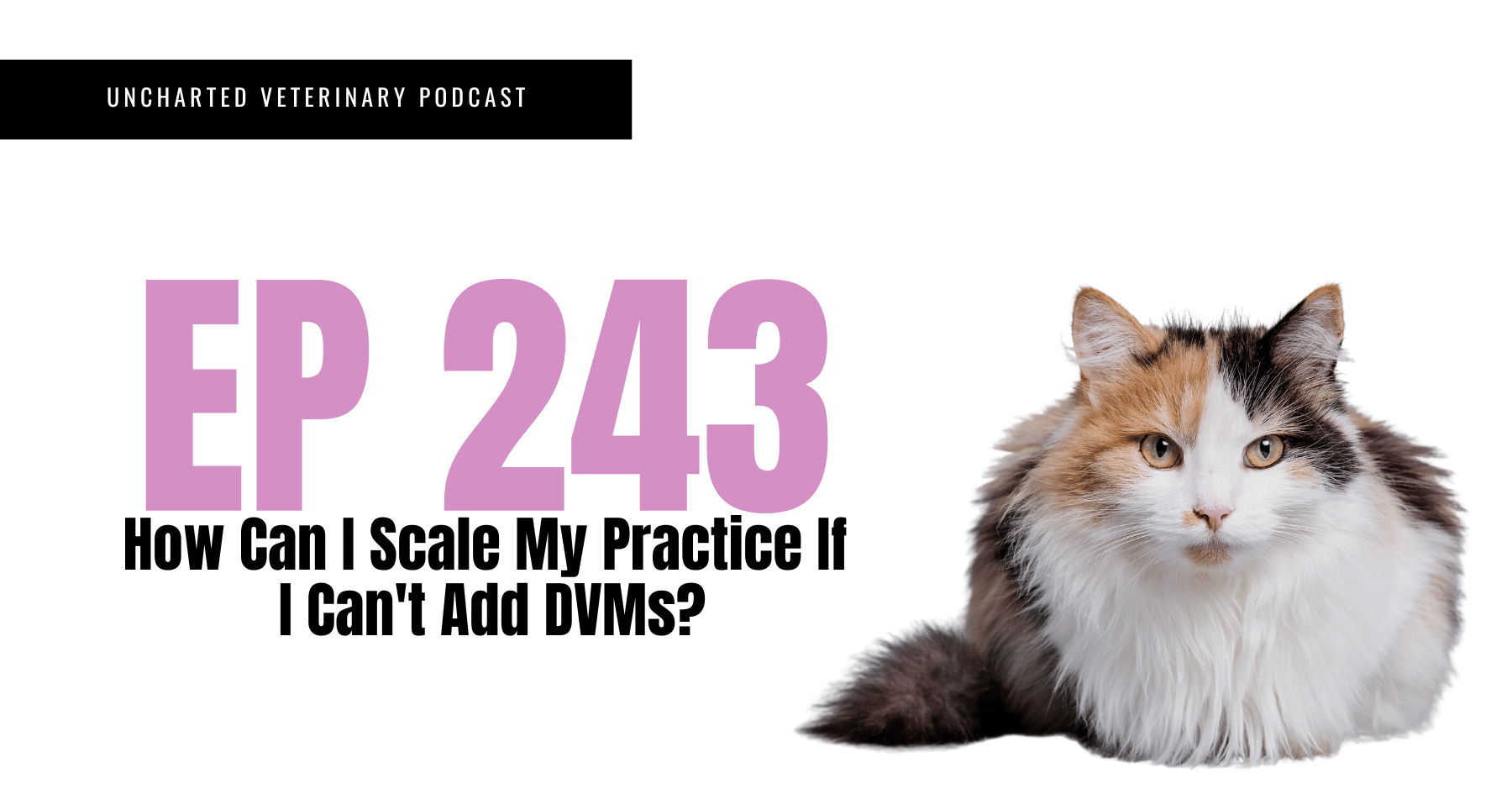
How Can I Scale My Practice If I Can’t Add DVMs?

This week on the podcast…

This week on the Uncharted Podcast, Dr. Andy Roark and practice management geek Stephanie Goss are deep in a conversation that was inspired by a recent discussion with a colleague about how to scale up the size of their practice when it feels like everyone else is paying WAY more than they are for associate veterinarian salaries. After a promising interview, one of our friends was highly disappointed when the associate candidate went somewhere else for a starting salary that was more than this practice owner pays themselves. Where do you even start with trying to grow when it feels like money is tight? Let's get into this…

Uncharted Veterinary Podcast · UVP – 243 – How Can I Scale My Practice If I Can't Add DVMs?

You can also listen to the episode on Apple Podcasts, Spotify, Google Podcasts, Amazon Music or wherever you get your podcasts.

Do you have something that you would love Andy and Stephanie to role play on the podcast – a situation where you would love some examples of what someone else would say and how they would say it? If so, send us a message through the mailbag! We want to hear your challenges and would love to feature your scenario on the podcast. Head over to the mailbag and submit it here

Submit your questions here: unchartedvet.com/mailbag


Upcoming Events

All Upcoming Events


Episode Transcript

Stephanie Goss:

How many times have you called a client in the last three days, left a voicemail and then had somebody call back and say, “I had a missed call from you,” not even having listened to the voicemail? Look, the data shows clients want texting, they want online and digital communication. So, if your practice does not offer texting two-way with your clients, you are missing out in a big way. And you're also in luck because our friends at Simple Texting have done the research that one in three clients check their text notifications within a minute of receiving a text. One in three. And that goes up to 85% of all of our clients within the first five minutes after receiving a text.

So, if you are listening to this and your practice isn't yet texting two-way with your clients, you are missing out in a big way. And I don't want you to miss out anymore and neither does Andy. So our friends at Simple Texting have put together a deal for you, our Uncharted listeners. That's right, they have got texting plans that you can try for free for 14 days. But if you go to simpletexting.com/uncharted, they are going to give you up to $100 worth of free credits when you sign up for texting for your clinic. There is no reason, none whatsoever today, to not be texting with your clients. So if this is you, head over to simpletexting.com/uncharted. Get your deal, check out all of the amazing options.

Let's get into it.

Hey everybody, I am Stephanie Goss and this is another episode of the Uncharted Podcast. This week on the podcast, Andy and I are tackling a conversation that was inspired by a discussion with a colleague of ours who is struggling after having interviewed what felt like a really promising associate veterinarian. Only to find out that they took a job at another practice that is offering significantly more money than they can. They're wondering how in the heck they get ahead when they couldn't even pay themselves what this new associate is earning elsewhere, and wondering how in the heck to start scaling up their practice. This was a really fun conversation. Let's get into it.

Speaker 2:

And now the Uncharted Podcast.

Dr. Andy Roark:

And we are back. It's me, Dr. Andy Roark and the one and only Stephanie, Big Time, I'm on my way, I'm making it, Goss.

Stephanie Goss:

Can you please sing that song because I have no idea what-

Dr. Andy Roark:

You don't know Big Time? (Singing). You should listen to it. Peter Gabriel… First of all, you just dated yourself as younger than me.

Stephanie Goss:

No. But from your introduction, I was like, “I don't know actually what song he's referencing because-“

Dr. Andy Roark:

(Singing). It's such a weird song. I enjoy it. I like weird songs.

Stephanie Goss:

Also, because I like making you sing. How's it going Andy?

Dr. Andy Roark:

I am so not a good singer. It's good. It is good. Yeah. Cannot complain. Yeah, things are good. Summer's rolling along. Life is good. Staying busy. Yeah, I'm trying to think if there's anything else to tell you.

Stephanie Goss:

It is busy.

Dr. Andy Roark:

Yeah.

Stephanie Goss:

It's so busy right now.

Dr. Andy Roark:

It's just been a while. It's been, yeah, a wild summer.

Stephanie Goss:

So I have a question to ask you.

Dr. Andy Roark:

Yeah, sure.

Stephanie Goss:

I have been waiting. So you just got back from some time off? I need to know, was there a repeat of last year's beach chair saga when you went for beach week with your family?

Dr. Andy Roark:

I thought of you on the beach and I went and I sat my thing out and I remember the two people who came and sat right in front of me and no one did, which shows that I'm not crazy because last year I was like, “Boy, those people acted like I was the jerk” because they just came and sat right in front of me and my tent, between me and the beach and oh, they just came and put their chair. I was on a blissful beach by myself, no one else there. And these people came with their chairs and literally sat right in front of me between me and the beach. And when I said, “Hey, could you please move?” They acted like I was the biggest jerk. And so it was funny, I was sitting there in the sand looking in the beach and I a hundred percent thought of this story and I thought about you.

Stephanie Goss:

I've been waiting. I'm like, “Okay, Andy, this is the first day we've worked together since you have been back. And I'm just like, I can't leave to go on my vacation without knowing. Did we have a repeat of last year's beach saga?”

Dr. Andy Roark:

We did not. It seems like the moral fabric holding America together is actually holding up okay. I thought it was just totally coming apart.

Stephanie Goss:

Oh my gosh, that's so funny. So funny.

Dr. Andy Roark:

I will tell you this though. All right, so we're getting ready to go and the day before we leave, I got a call from the boarding facility, Noble Dog. The Noble Dog Hotel where Skipper Roark stays. And they were like, “We have to give you some news.” And I of course I'm freaking out whenever the boarding place called you the day before, you're like, “Oh no.” And they were like, “I just wanted you to know that Skipper is going to have to stay in the restricted playgroup.” And I said, “Why?” And as if I didn't know, I was like… And she was clearly uncomfortable. So this is the thing about me is when I know that someone is uncomfortable-

Stephanie Goss:

You've got to make them more uncomfortable.

Dr. Andy Roark:

I'm going to make it worse. Stephanie is like-

Stephanie Goss:

I know this from lots of experience.

Dr. Andy Roark:

And so she's like-

Stephanie Goss:

This poor girl.

Dr. Andy Roark:

Yes. So she's like Steph… Or she's like, “Skipper.” Stephanie also. Stephanie Goss also needs to be in the restricted playgroup, but for different reasons. Skipper Roark is in the restricted playgroup. And I said, “Why?” And she's like, “He's too.” And she's clearly struggling. She goes, “He's an aggressive humper, he's an aggressive humper.” And I was like, “Are you sure?” And she was like, “I'm afraid so.” And so I said, “Who's going to be in the restricted group?” And she's like “Big dogs.” And I was like, “Okay, but he's not going to be alone?” And she was like, “Oh no, no, there's going to be other dogs, but just not-“

Stephanie Goss:

He can't be with the little dogs.

Dr. Andy Roark:

Yes, he can't be with the little dogs.

Stephanie Goss:

Which is so funny because I had the dog that was the opposite to Skipper because I had the big dog that had to be with the little dogs because she was afraid of her own shadow and she was about a thousand times their size. But you would pick her up and she'd be out there with all the little micro chihuahuas and be happy as can be.

Dr. Andy Roark:

Oh yeah. No skipper's just annoying. He's just annoying. He's not bad, well, he's bad, but he's… Mostly, he's just annoy… He has no chill. He has no… You know when you take a dog to the dog park and they immediately get there and try to sniff everybody, that's Skipper. But it doesn't stop. The whole time he's in the dog park he is in that mode. He annoys me and he is not even sniffing me. So I take him there. And so I take him and I go to drop him off and she's like, “Yeah, as we said, he's in the restricted playgroup and I just need you to initial this sheet.”

And so she slides me the sheet and [inaudible 00:07:45] and on the sheet it says, they have all the little boarding parts all typed out and it says, “No Buster Zelensky on his sheet.” And I said, “What's a Buster Zelensky?” And she said, “Oh, he's another dog.” And I was like, “Oh.” And I said, “Buster doesn't get along with Skipper?” And she was like, “No, Buster particularly doesn't like Skipper.” And as I left for the beach, I left with the knowledge that there was a Buster Zelensky form somewhere that said, “No Skipper Roark” on it. And it made me happy. I was like-

Stephanie Goss:

So you have officially become that client?

Dr. Andy Roark:

Yeah, no, Buster Zelensky's owners dropped that dog off and they have to initial a thing that says “No Skipper.”

Stephanie Goss:

No Skipper Roark.

Dr. Andy Roark:

So anyway.

Stephanie Goss:

Oh my gosh. Skipper has reached a whole new level of bad dog.

Dr. Andy Roark:

I keep thinking he's going to mellow, but he's just not. And oh, Jacqueline was like, she's like, “I wonder if those guys would've traded Moose for Skipper” because Moose was the dog we met, when we were hiking. And I was like, “Boy, if they would do that deal, I'd fly him out here for him.” If it was a straight-up Moose, the golden retriever who I met for all of three minutes or Skipper Roark who I've had for five years going with Moose.

Stephanie Goss:

Poor Skipper.

Dr. Andy Roark:

[inaudible 00:09:16].

Stephanie Goss:

Okay.

I'm excited because we have been having a lot of conversation in the Uncharted community about growing practices and about finding new doctors. And I think everybody in veterinary medicine knows that we're facing a massive veterinarian shortage. And there's like, I don't know, I think the last study I saw, I feel like it was out of AVMA, but was like there's something like 18 open veterinarian positions for every one new graduate coming out of school. And so there's tons of jobs and not enough people and everybody's looking at how can they grow their practices and how can they be attractive, particularly smaller hospitals in an environment in vet med that is rapidly getting bigger in terms of corporates. And so I think there's this perception, I'm just going to say it up front. This is probably going to be an episode where Stephanie steps on a soapbox a few times. Because I think there's this perception of bet med that corporates have this magic money tree that they just shake and all the money falls out and they can pay veterinarians way more than the small guy.

And I know I've had this conversation with some of my friends and so we had one of our community members who was asking some questions and they were like, “I'm trying to grow my practice and I'm looking at this and I would like to have the discussion.” And you and I had gotten a letter in the mailbag at the same time from a clinic who was like, “Hey, I just recently interviewed a vet and I thought it went really, really well. We really connected. It seemed like a great cultural fit. So I made an offer and then I had a follow-up conversation and they were like, ‘I really loved you and I really loved the practice and I'm taking another job in the area because they offered me a schedule that was only working three days a week and for significantly more money. And so I really appreciate your time, but this is what I'm going to do.'”

And so the writer in the mailbag was saying, “I'm feeling really frustrated and I feel like I'm doing something wrong because I can't pay that much. And I know that there are things that I'll be able to do for my practice, for my patients, for my team if I grow the practice. How do I get bigger if I can't add doctors?” And that has been the conversation within our community is like, “How do we make that jump into the bigger pond from a one or two, one and a half doctor practice? How do we make that leap?” Because when you're that size, it feels insurmountable, the comparison between yourself and the big guys. And I just thought it was such a fun conversation and I am really looking forward to diving into this one with you.

Dr. Andy Roark:

Yeah, no, I like this a lot. I think this is good. Let's just start to roll into the head space here. So you're the practice owner, practice manager, team lead, whatever, where you're like, “This has just happened and I'm reacting to it.” The first thing that I want to say to people… I'm going to start off this by being annoying just so you know I'm going to be annoying-

Stephanie Goss:

You're going to be Skipper-

Dr. Andy Roark:

Because I'm-

Stephanie Goss:

Okay, let's do it.

Dr. Andy Roark:

No, I'm going to be that person who says things that you know are true, but you really don't want to hear it and it's just annoying. And I'm going to ask some questions that at first you're like, “Why would you ask that stupid question?” And then you're like, “Okay.” And I'm probably going to make it a bit more complicated than it feels like it should be. Because people generally come to us and they have this question and they're like, “How do I scale my practice?” And what they want us to say is, “Here, sell this widget that you didn't know existed.”

Stephanie Goss:

Here's the magic recipe.

Dr. Andy Roark:

“Add this service that you are unaware of and voila scaled practice.” And of course, of course it's not true. We're going to go into that first of all. So I'm just going to go ahead and give that annoying warning of this is going to be a little frustrating if you were like, “I've got my pen and paper. Tell me the thing to do to grow the revenue in my practice immediately.”

Stephanie Goss:

This is not that episode.

Dr. Andy Roark:

It's going to be a disappointment, yeah.

All right, so I'm going to start with a frustrating thing that people say, but I say it all the time. Comparison is the thief of joy. And here's what I mean before people go, “Wait a second, this is, what are we talking about?” Comparison is the thief of joy. Comparing your little independent practice to one of the thousands of practices owned by the Mars Corporation is a losing proposition. Especially if you let them frame up the comparison meaning, “I'm going to look at them and think about all the things they can do that I can't do or all the things they have that I don't have.” And I say, if that's how you're going to look at this, you are always going to be unhappy with the beautiful little practice that you built and that you run. You're just going to feel bad about yourself all the time because you're never going to have that level of resources. You're just not.

I had an article that came out in Today's Veterinary Business earlier this month. It came out in the June issue. And it was about the rulers we choose, meaning measuring rulers. We all pick how we define success. And so you got to be really careful about what rulers you choose to measure your practice. And so I know that's not what the person's writing about, but I just want to say it up front and say, if you compare yourself in the ways that the big corporations have huge advantages, you're always going to feel like you're failing or your practice is less than. But guys, that's not the only measure and that's not how most people see the world. It's really not.

The other thing I'll say that I have found that people don't like to hear this, it sucks, but it's not true, is it's not a fair game in a lot of ways. Meaning, my gut is that this is less common than it was, but for a while, a couple of years ago we had a lot of groups that were buying up practices and they had a lot of private equity money behind them and they were in growth mode. And so they just had these buckets of money that did not make sense and they were spending money that had no basis in business reality. And we heard horror stories about… it's not horror stories depending on who you are. And again, I'm not trying to knock the medical providers on the other side of this, but there were companies that were dropping money on doctor salaries, especially new graduate doctor salaries, and they were dropping these huge contracts on doctors and independent practices were looking and saying “That doctor is never going to produce enough money to justify what they're being paid by any realistic metric or measurement. How is this happening?”

And I think it affected me at the time because I've always been one who said, “The numbers have to make sense and we're all playing this game where the numbers have to make sense,” but when you have this investment money that's coming in, the numbers, at least in the short term, don't have to make sense. And so there were just things that were not… There was not a way that you could compete with them as far as dollars and what they were doing. Just it did not square up. Now, the good news is those birds always come home to roost. At some point the people who are spending that money, they're expecting a return on their investment and that is… So things are going to come back around, they're going to have to even out. And I think we're already seeing that. I think a lot of that stuff has started to mellow out a bit, but it still goes on.

And if you're a little independent practice, you just don't have private equity money that says “Get bigger, get bigger. I don't care what it costs.” You're just playing a different game. And so the first thing I would say is comparison is a thief of joy and it can be frustrating and you have the right to be frustrated and I think everybody would be frustrated. However, you need to think about why you got into this and you need to think about what is important to you about having a practice and why your practice is special and how you are going to measure success. Because if you measure success as a race against the Mars Company to earn profit, I'm like, “Buddy, you're taking a pocket knife into a nuclear arms race. You're not supposed to be here”

You're not doing anything wrong, but man, the way that we frame success in our minds is a big deal. And so we're talking about head space. Be kind to yourself, recognize where you're comparing yourself and just try to put that down and say, “Given that this is the landscape we live in, how am I going to be successful in the way that I want to be successful?” And that it's so much healthier and it will make you so much happier and you'll still have a good business, but you're not fighting an unwinnable battle.

And the worst thing that I see is small independent practices that have huge hearts and people on the ground that love the practice and want it to be special, giving up their love and the things that make their practice special to try to chase after someone who's not bad, they're just running an entirely different model and they're playing a different game from you. And so I've seen people give up the things that they love and that make them unique so that they could try to run after a massive corporation that's just playing the capitalism game. And that's not bad. But God, don't give up the magic. Don't be upset with your beautiful baby because it's not something totally different than what you made it to be.

Stephanie Goss:

I agree with you a hundred percent on the comparison piece. And I think the other piece of it is, for me is sitting back and asking yourself what do you actually want and why do you want it? I think you need to know what why is to drive yourself. But I ask, it's so often… To your point about playing the comparison game, so often I talk to independent practices and I'm like, “What is it that you want and what is being driven by should?” They think that they should be doing this. They think that this is the next step they should take, but there's not actually a why behind that. It's like, “I have one doctor and I want to retire and so I need another doctor”, okay, that makes sense. “Well, I have two doctors and I feel like the next step should be that I should get to three or four.” Why? What's the why there? Do you want a bigger practice? Do you want to employ more people? Do you want to get a bigger facility and in order to do that you need more? What is the why?

I think that for me, the head space starts with sitting back and looking at what are you trying to do and why are you trying to do it? Because you need to get really crystal clear. For me as a manager, the questions that I'm going to ask you have to do with numbers and sense. And if you don't know why you're trying to do what you are trying to do, you're not going to be able to answer any of my questions and you're not going to be able to solve this problem. And I think that that's the thing that I have seen time and time again. I've had conversations with practice owners and practice managers who are just like, “This is an unsolvable problem. I'm just going to give up because I can't compete.” And to your point, we're often competing with a should or a thing like competing with it, being a small practice, trying to look and measure yourself comparative to a giant corporation. That's not the right question to be asking yourself.

Dr. Andy Roark:

You're speaking to my soul. Man, the whole should game, it's so hard to get away from and it's a byproduct in some ways, I think, of access to information that we have now that we didn't use to. I don't know that most people running vet clinics pre-internet knew what other vet clinics were doing. They definitely were not bombarded with these continued messages about what it means to have a “successful practice.” They were just largely out there doing their thing. And I'm not convinced that that's so bad, really as long as you are happy and people would say, “But by having the best business practices hammered into us, we've made better practices financially.” And that is true and knowledge is power, but I think that there's that this is what you're supposed to do with your practice or this is what you're supposed to do with your career.

And so I want to expand it out because I've been seeing this a lot. There are messages about what a practice is supposed to look like and what the life of a practice is supposed to be, which is bigger, bigger, bigger. Or if you can't get bigger, multiples. If you not going to grow this practice, you need to have a second practice. And I go, “Who made that the case? Who said that's what should happen?” And it's been amazing, over the last five years, I have seen more people pushing back against that and saying, “I don't want to run a bigger practice. I want to run this practice with fewer headaches. I want to run this practice and just have it run more smoothly and simply. I'd like this practice to be more profitable, yes, but I don't want to manage seven doctors. I like managing two doctors plus myself and that's what I enjoy.”

Lifestyle business is not a dirty word. It shouldn't be. Some people say it is. I've felt that way as people are like, “Oh, a lifestyle business, that just means you didn't build something that could scale.” And it goes, “No, I strongly disagree with that.” It means you decided what you wanted to create and what was important to you and you made it, but boy, should is such a powerful thing. There's so many doctors that feel like they should move into management, but they don't want to move to management. But that's what you're supposed to do because it shows that you have your ish together and that's what you do.

And we see it even more in the paraprofessionals, which means you're a good tech, you should be the head tech. And you're the head tech and you're doing a good job, you should be the practice manager. And then if you're in a corporate structure, you should be a regional manager. And onward and upward and you go, “Why is that what should happen?” What if you don't want that? What if that's not what's interesting to you? But man, this is the march that should happen. That's such a powerful force.

And so I want to tag onto that as well. And so it's interesting, and I said I was going to be annoying at the beginning, but we get this question and it says, “How do I scale my business if I can't add DVMs?” That's the question. And so I push back on that and say, are you sure that you have the right outcome that you care about? Is financial growth generating more money…is that really what you want and care about? And so we talk a lot about root cause analysis. I would say, why is scaling important to you? And I don't know what they would say. I would guess they would say something like, “I want to be able to attract veterinarians that want to come so that we can handle the workload that we have.” And that's really important is “I want to attract enough people that I can serve my community.”

And then I would say, great, do you recognize now that scaling and generating more revenue is a way to attract more doctors, but really what you want is to attract more doctors. It's not to generate more revenue. The revenue is a means to an end and the end being “I want to be a place that people want to come and stay.” And so I hope that you see that I've already tried to cut loose the bonds that are around your hand and say, “This doesn't have to be about money.” Sure, let's see if we can get our practice to be a bit more profitable so that we can sweeten the pot, but ultimately we may never be just minting money. I'm confident there are other ways that we can find people who want to work with us. And I'm confident that we have other things that we can offer.

And I think you're going to have a much easier time digging into the culture that you have and what makes your practice special and trying to find people who match and who said, “Yes, this is where I want to be.” Then you are ratcheting up your income so that you can compete with the specialty hospital that's trying to hire emergency doctors or whatever. I think that those can be very different things.

Stephanie Goss:

The other thing too, I think that goes back to the why. Because to your point, if my why is I want to grow because I want to retire and I need somebody to take this place over or I need to be saleable, then I would say, “What does that look like to you? Are you talking about trying to retire in the next five years or are you talking about trying to retire 20 years from now?” Because the strategy that I apply to that why, if your why is to get out in the next five years. I'm going to look at that from a very different strategy perspective than a plan that involves a 20-year timeline. Because do you really need another doctor today if you want to get out in 20 years or is it worth finding the right doctor, to your point, who is someone who wants to be a part of the community, who wants to take care of those clients, who wants to take care of those patients? Can you wait to find the right fit? Or is the why requiring a different plan of action?

And so I think you can't figure out how to solve this problem until you know the answer to that question. So I love your idea of asking yourself the root cause analysis and asking the fivefold why. Why do I want to do this? Why do I want to do that? And trying to figure out what is it that you're actually trying to accomplish?

Dr. Andy Roark:

Yeah, that's exactly it. And in that same vein, one of the things that I've been thinking a lot about recently is that we tend to tell ourselves that there are outcomes that we need. And if we can achieve this outcome, everything will be fine. If I can just generate more money in our practice, then everything will be great. If I can just get this degree that I have been fantasizing about, then everything will be great. If I could just move to the West Coast, then life would be so much better and I would have what I wanted. Whatever those things are-

Stephanie Goss:

It would, by the way.

Dr. Andy Roark:

But we have those thoughts. And so what I've been thinking a lot about recently is this idea that generally outcomes do not make that much of a difference to us. And when we say… Meaning, and I always talk about there is no dragon, meaning I spent a lot of my life chasing outcomes, chasing dragons to slay, problems to solve, challenges to overcome. And what I found is there is no challenge that you overcome and it makes you whole or it makes you happy, or makes you know that you're successful or know that you're worthy. That dragon doesn't exist. There is no dragon. And so it's the same thing with all these outcomes. And I go, “Okay, I think that we convince ourselves if I can get this outcome, my problems will go away.”

And so the workaround here and what I found great power is I don't think we really want outcomes. I think that we imagine we are going to feel a certain way or have a certain experience if we achieve an outcome. If I get this degree, I will feel confident. If I move to the West Coast, I will feel like I have freedom. I'll feel like I have freedom, I'll be out from under whatever constraints I have here. But I will feel free if I move to the West Coast. If I generate this revenue, then I'll have security. If I had more money, I would feel safe. And so there's feelings that are tied to these outcomes and so keep walking with me.

If you can recognize that, oftentimes you can identify the emotion that you're trying to have, the feeling or experience you're trying to have. You can often just go ahead and do things to get that feeling without going through the whole process of getting whatever this big outcome is that you want. And so for example, if you say, “I desperately need our practice to generate $10 million a year in revenue,” and I would say, how do you think you're going to feel when your practice generates $10 million in revenue? And you said to me, “I'm going to feel safe. I'm going to know that I'm okay. I'm going to know that if hard times come, we are fine and I'll be great.”

Now, I could at this point say, “Just so you know, when you get $10 million, you're not going to feel safe because you're going to have to keep making $10 million to keep paying your staff and it never ends.” I told you I was going to be a jerk, but I would not say that to the person. Instead, I would just let that go and I would not say anything about it. And I would say, “What can you do right now to generate feelings of safety? Are there things that we can do that are not making $10 million that can still make us feel safe? Maybe that's having a plan, maybe that's looking at our insurance coverage. Maybe that's figuring out what plan B is going to be and just being okay with it. Maybe it's thinking through what the worst case scenario is. Maybe it's making a series of safety checks that are going to stop us from getting there. But what is that? What can we do now to give you that experience?

And so going to the person who said, “How do I scale when I can't add DVMs?” What I want to say is, how are you going to feel when you do “Scale”? How's that going to make you feel? Is that going to make you feel free because you can have more time off? Is that going to make you feel… Is it going to make you feel successful because you feel like you're taking care of your community? Is that going to make you feel safe because you feel like you're not going to have your employees boycott and quit on you? And now my friends, this is why I love this so much. I get excited about these exerciseS, but I really love this, because depending on what you said to me, I would give you different recommendations.

So if you said, “If I could scale, then I would feel free because I have time off,” I would say maybe the question is not how do I scale? Maybe the question is how do I get more freedom? How do I get more time off? Because you don't need to generate revenue necessarily to have time off. There's other things that we can do. If you said, “I want to serve my community,” I go, “Great, are there other ways besides generating revenue and getting bigger that we can serve our community?” So maybe we can get that experience, that thing we want without having to go through the financial part.

And then again, if it's a safety thing, I would say, “Hey, you're not going to believe this, but getting bigger and taking on more employees, it may not actually make you feel safer.”

Stephanie Goss:

It might be more scary.

Dr. Andy Roark:

It might be more scary when you get there. And again, but what are the things that we can do now to create that?

So anyway, again, I hope that's not too woo-woo or out there, but these are things that I really think a lot about and I just… They're ideas that I'm really excited about and I just have seen so much good come out of the idea of, all right, I see that you're striving… Because we have so many people who are in our profession and they're striving and they're striving and they're striving. And that question of how are you going to feel when you get there? Imagine you succeed, what's it going to get for you? How are you going to… What's that experience going to be? Man, that is a powerful tool to understand what makes people run. A lot of times people are like, “I won't be afraid anymore.” And I'm like, “I hate to tell you, but yeah, you will be.” And so let's figure out what we can do right here and now to not be driven by fear or whatever the thing is.

Stephanie Goss:

And I'm going to be vulnerable and share. So Andy did this exercise on me one time. This is where I thought you were going when you started talking about-

Dr. Andy Roark:

I don't remember this story. No, I'm [inaudible 00:33:43]. I have such a bad memory. It's great. I'm just like every day's a new journey when people tell me what we did yesterday. It's not that bad-

Stephanie Goss:

You and I were and I were together at a conference and we were sitting down and we were having conversation about development, because you mentioned school, you asked me about development and I was like, “I feel like I probably should consider getting my MBA” and the word should came up and you were just like, “Tell me more.” And I was just like, “Well,” and I had to sit there and think about it and it was really hard. And I was just like, “Well, this is… I like education, I like growing and developing myself and I feel like I've done the practical experience things and getting my MBA would continue to fle sh out my book learning education. And I feel like I could learn things outside of veterinary medicine that I could apply.” And I don't know what else I said, but you were like, “Okay, and what would you do with that?” So you were asking me these questions and I was sitting there and I was just like… It was real hard.

Dr. Andy Roark:

Yeah, I remember this conversation.

Stephanie Goss:

Was just like, “I don't know.” And ultimately we were sitting there and Andy made me cry, as he does. So I'm sitting there and I can't–

Dr. Andy Roark:

Not in a bad way, not in a bad… I just want to-

Stephanie Goss:

Not in a bad way, not in a bad way-

Dr. Andy Roark:

It was not a bad-

Stephanie Goss:

I started-

Dr. Andy Roark:

How dare you? Like no, it was not that.

Stephanie Goss:

Because I'm sitting there and I'm realizing, as Andy said, that a lot of it was tied up in feelings and emotions. And what I realized was that the reason why I said I thought my development goal should be to get my MBA had a lot to do with feelings and emotions. And I will tell you guys, I left that conference and I did not go sign up for an MBA. I took some of that money that I would've spent on getting my MBA. And I took myself to therapy and I started working on some of the feelings and the emotions and I actually started working with the coach and working on the feelings. Because for me, the should was motivated by personal feelings of imposter syndrome and that I didn't think that I measured up.

And for me, in my head, the story I had told myself was that if I have this piece of paper that I will be able to feel like I am qualified to be where I am and I will have letters behind my name that will make other people look at me in a different way. And what I realized through the course of the conversation was, oh, okay, A, I'm being driven by a should and that's not actually a good thing here. And also B, the why was important and I needed to do that work and dive into the feelings and do some self-work. And I think had I gone into an MBA program at that point in time, I don't think that I would have gotten out of it what I could get out of it if I went through a program like that. Now, because I had done the… I did a lot of hard work in between that conversation and where we are now. And so I think I would've had a different experience.

And so I am so glad that you talked about that and also recognizing that this is hard and this is a lot of hard work. And if you come by the answers to why very quickly when you sit down to do this, if Andy or I was in the room with you, we would both look at you and say, “That was too easy, start over, try harder.” Because the answer should not be quick and it should be hard. This should be a hard process, but the hard is worth it at the end. Because if you know your why, that's where you then can move yourself really comfortably into the action step part of this conversation. But from a manager perspective and a leadership support perspective, if you're not crystal clear as an owner on the why of why do I want to scale my practice, where am I trying to go? I can't help you. You could pay a consultant thousands, hundreds of thousands of dollars and they're still not going to be able to help you figure it out either. You have to know what that why is.

Dr. Andy Roark:

Yeah, I remember that conversation. It was a really good conversation and the way I remember it was, you said, “I want to do this MBA,” and I said, I went through the exercise with you and I was like, “Why is that important and what do you think is going to be different when you have this and things?” And so it was, it's funny because you felt like “I should do this, I need this, it's going to change the way that people look at me and blah-blah-blah.” And we talked about it and the way that I saw you from the outside, which was fascinating was that Uncharted was growing so fast and you were right in the middle of it. And I'm like, “Here's someone who's buried in opportunities. Our biggest problem is not, we don't have opportunities, we have too many opportunities.” And that was it.

And you were like, “I need more education.” And I'm like, “We are having people throwing work at us and we can't get done the stuff that we are getting. And it's good, we can't do all the things we're excited about right now.” And so going and getting something… And again, I'm saying this because I don't want people to think, “Oh, Andy and Stephanie don't like MBAs.” It's not that, but it was just like you were like, “People look at me differently” and I just see people with this adoration in their eyes. And you had just lectured to a room of 700 people. I was glad I wasn't in the program. Because I was like, “I don't want to hear from Goss how she had twice as many people in a room as me.”

Literally, I couldn't get into the room that you were lecturing in. And you're like, “Yeah, I think people will look at me differently if I had this MBA” and I'm like, “You're out of your mind. What are you talking about?” I hope it's okay for me to say that, but –

Stephanie Goss:

And then I started crying.

Dr. Andy Roark:

And that's when you cried and that's when you cried. It was much more of a fatherly Andy like “Hmm, let's think about this.” But ultimately that's where the conversation went. But it was that. But it was really fascinating. It was really fascinating as your friend to have the talk with you. But it was that thing of… To be honest, it's intimidating to go up and talk in front of all these people and you have these feelings of like “I'm supposed to have all the answers and I'm supposed to be able to fix. Every one of them should be able to throw their practice at me and I can fix it in the air.”

But we have those should expectations of, and again, the outcome is a great example “If I had this M B A, then I could do that and if I couldn't, I would feel okay, because I would still know that I knew my stuff” and I go, “I don't think that's true.” But anyway, thank you for sharing that. But yeah, it was… Yeah, I'll always remember that of, man, we've all got these should ideas. But anyway, I'm just a big believer in that. So anyway, that's my stuff.

As we start to look at, yeah, how do I scale the practice? I wanted to get all those things out. Of course I still want to answer the question of scaling and how can we drive revenue, but I really do want to think that just because of where this comes from, the last thing that I want to say, and this could go in the action steps, but I'm going to put it in head space real quick and then I'm going to be done. Is when you're the owner, when you're the medical director, when you're the manager and we start to have thoughts like this and we're like, “We need to scale so that we can attract doctors” and things like that, it is so easy to turn to your team and essentially say, “We need to make more money. I need you guys to make more money, let's make more money. Don't you understand that we have to make more money in order to be able to pay you guys? Guys, we're going to be in trouble if we don't make more money.”

And as the team leader, when you have that either internally, that push of “We need to scale so that we can grow so we can serve the community” or that comes down from above, you have got to be so careful because there are very few things that turn that teams off as much as someone turning to them and saying, “We have to make more money, don't you know.” Even if it's for them. And people go, “But I tell them, it's so I can pay you guys.” And I'm going, “I still find that to be hugely demotivational.” Because for a long time I thought, “If they know it's so their salaries can go up, they feel differently.” And I think there's something to that, but still, I think a lot of people overplay that. It's like a lot of your people are not there for the money and when you start talking about the money, they can immediately flip to a place of, “Oh, I see what's happened. This is all about the money. That's what this place is about.” Or “That's what this leader is about.” And boy, you lose credibility really fast.

It's a real culture clash in that medicine where a lot of people immediately get turned right off about that. And so you just have to be careful when you start to… That's another reason why I go through what are we really trying to do here? Because you have to be really careful about how we talk to our team about we need to make more money, we need to increase revenue. Because if you don't do a good job of communicating the why and getting them on board, you're going to really turn them off.

Stephanie Goss:

Do you want to take a quick break and then come back and talk some action steps?

Dr. Andy Roark:

Yeah, let's do it.

Stephanie Goss:

All right.

Hey friends. I want to make sure that you don't miss an opportunity to talk about topics like the one we talked about on the podcast today. That's right. In October, and October 11th to be precise, we are doing our fall virtual conference. This year, we're tackling culture and I cannot wait to dive into topics about accountability and creating a culture of accountability in our practices and how do we build trust and work together. And it is going to be so much fun. We have jam-packed a one-day schedule to make it not too difficult for you to get off the floor at the practice and participate. Even though it's virtual, we build a community and connections and love to talk to one another. So this is not your passive watch CE on a screen. We are going to be doing interactive workshops, interactive discussions. We've got our choose your own adventure format and I cannot wait to dive into it. So head over to the website at unchartedvet.com/events and sign up for our culture conference happening October 11th. See you there.

Dr. Andy Roark:

All right, so let's start to do our action steps. Big things that stress coming in. Opening language that I always like for things like this when we're about to make change, especially we're starting to pushing into revenue, things like that. Anywhere we're going to start changing the way that we work, I'm a big fan of going to the team and not saying, “Guys, we got to make changes. Guys, this is not working. We can't keep up with the other guys. We got to make changes.” That's scary and it's demotivational. The best way to go at this is to say, “Guys, I love our practice. We are doing great. You guys are doing great. I see and appreciate you and we are going to the next level. We are going to make some changes. I want to start empowering our paraprofessionals more. I want to grow what we're doing. I want to help more pet owners. Guys, we can do this.”

And you feel the difference in just those two approaches. I see a lot of times… And I get it, I a hundred percent get it. It's so easy to go and say, “Guys, I'm going to be honest with you.” And again, I'm not talking about lying to people, get me wrong, but oftentimes we can frame it as “This is not working, we need to do things differently” or “You guys are amazing and we're going to do things differently so we can continue to grow.” The second is much more positive and motivational. And I think if we can frame things in that light, people tend to get on board a lot faster.

Stephanie Goss:

Yeah, I would agree with that. And I think that goes back to if you know why you're doing what you're doing, it's really easy for you to frame that. What are we going to take to the next level? It's like we want to focus on efficiency and we want to focus… Because we want to be able to take care of more patients. The whole rest of that conversation comes so much easier when you know what that why is that's driving it.

Dr. Andy Roark:

Yeah, I completely agree. All right, so seeing that we're going to go down this road, we say how do we scale without doctors is a question, meaning how do we drive more revenue without more doctors? All right, cool. There's four levers that we can pull and usually the answer is not to pick one of these levers and pull it really hard. Usually the answer is to pick a couple of these levers, maybe start with one and do it and be gentle and pilot program and try it out and then pull a second one. And over the course of 6, 12, 18 months, start to make some adjustments here. But basically there's four levers in my mind. The first one is the price lever. It's the easiest one. Be careful. Definitely you can go to this too often, but the fastest path to success into cash or the fastest path to cash is increasing prices.

Whether you embrace them across the board or on the top 25 most common items, things like that. It's a quick way to generate revenue. Most practices have more upward mobility than they think they do. I understand why people don't like increasing prices. Of course, obviously there's a ceiling to this, but just as far as ease of implementation and straightforwardness, can you raise your prices? A straight price increase tends to generate a lot more revenue. And again, for people who don't think about this a lot, remember that when you run your business, you have a lot of fixed costs, you have a certain amount of money that is going to payroll and it's going to your hard costs. Beyond that, that money is profit that you can use to do things like hire other people and increase salaries.

And so if you increase your prices by 5%, you're not increasing your profits by 5%. You might be increasing your profits by 50% if you were only 5% profitable. And so anyway, it has an outsized impact on the bottom line, the money that you have at the end. So increasing prices is where you got to start. Do you agree?

Stephanie Goss:

Yeah, I do. And I love that. And what I would say is from a math perspective. When we got this question, my mind immediately dove into the math of getting another veterinarian. And in this conversation it was like, “Hey, this doctor took another job and they're working less days and making 40% more than I offered them.” Okay, I can work with that. Because if I take what I offered and I know what 40% more of that is, if that's my goal, if that doctor was like, “I loved you, but I'm going to work less days and make more money,” okay, I might not be able to solve the less days problem. Maybe I could, maybe I couldn't. But let's set that aside and let's just look at the money for a second.

If they need 40% more, how much more do I have to pay them? And so just using round numbers for the sake of ease. Let's say I offered a hundred thousand dollars. That's $40,000 more, that if I was paying them 40% more, so it's $140,000 instead of a hundred. So I take that difference and say, “Okay, what would I have to do now?” To your point, about that's not the number that you're going to use, but it gives me a starting place to say, “Okay, if I want to be able to offer $40,000 more, then I need to be able to generate four times more than that.” If I was a doctor and I was just saying, “I'm going to offer you this salary,” the rule of thumb is we want to pay them a cap of 25% of what they earn. So if I multiply that times four, I know what I have to generate minimally in revenue to cover that $40,000.

Now all of a sudden I have hard numbers that I can work with to your first lever, which is prices and say, “If I need to generate overall $300,000, again just round numbers, $300,000 more in a year to pay this vet $40,000 more or a vet $40,000 more. How do I make $300,000? Can I do that on a price increase alone. What would that look like? Is it taking the top 25 things and raising them $2? Is it raising prices on not shopped items by a hundred dollars? Is it some combination of those things?” Now you have an end goal that helps you look much more clearly and in a focused way at the raising prices.

And it isn't just this like “I guess maybe I'm going to do a 2% price increase and hope that it makes me enough money that someday down the road I can pay another vet the money that they're asking for.” No, stop that. Stop it right now, let's look at the numbers and say, if you wanted to hire this vet tomorrow and you're feeling like you couldn't afford to pay them the $140,000, what do you have to do to get there? And you have to look at it from that concrete numbers perspective. And so looking at those prices, it allows you to say, “Oh, okay, if I increase my fecals by $10, how much of that 40,000 am I going to generate just doing the same amount of fecals as I did last year, not doing more, just the same things that I've already done?” And you can look at it from that hard numbers perspective.

Dr. Andy Roark:

Yeah, I love it. I think the second lever for me is increasing efficiency. This is, with the staff that we have, how do we more work? So how do we scale without adding doctors, basically? How do we do more work? I don't want to get too far into this, because [inaudible 00:51:51] be a whole thing. I think we've got podcasts, I'm sure we do on increasing efficiency. But a lot of this is… There's a couple things. One is just where do we get faster without giving up the client experience? And so some of it is training. Can we train on dentistry so that we're getting patients down and getting dentals done faster and getting people out, we can get more dentals done in a day, we can look at our systems to move more quickly and get these things done? Is we can add services like texting or things to make the front desk more efficiency? In-room checkout? Whatever the things are. And again, your practice is going to need different things.

Look at what happens in your practices and look at where things bogged down. Where are people standing with leashes waiting for help? What are they doing from a staffing capacity as far as having people where they're needed? But all of these things, I can keep going on and on and on. A lot of it is looking how do we get faster at what we're doing? And so a lot of times it's training. It's looking at our repeatable processes, the things that we do again and again and again and again in our day and figuring out how to make them go 10% faster. And boy, that makes a huge difference when you're talking about something you do hundreds of times. So anyway, that's the stuff that I'm starting to look at. Can I use technology to take weight off of communications at front desk? Things like that.

Stephanie Goss:

Yeah, I love it. I love it because from a management perspective, that's going to be the first question I ask an owner doctor who says to me, “I want to hire another vet.” Have we actually maxed out on our efficiency and capacity, or do we need more paraprofessional staff or do we need better trained paraprofessional staff? Where can we do things faster and more efficiently? And if the answer to that is no, that's where we have to start.

Dr. Andy Roark:

Yeah, I love it. So that's lever number two. Lever number three is shifting focus towards the profitable services. If you make a bunch of profit on fecals, let's just say, I used that earlier, can we increase the number of fecals that we do? And so there's absolutely like, “Hey, this is parasiticide and parasite detection is something that is a big driver for us. Let's start talking about our fecal compliance. If it's a big driver for us and we're 55% compliant, can we get up to 65% compliant? What would that look like?” And there's lots of different ways to do that as far as education, as far as adding things like drop-off cups and thing… I'm a huge fan of doing stuff like that. There's lots of different ways that we can do that.

Dentistry. Is dentistry a big driver for you? Are you maxed out in how you're talking about dentistry and what you're doing to get dental compliance? Can we start doing dental callbacks that say, “Hey, your pet was in and was given a grade two of four dental disease score and you were in six weeks ago and so we wanted to call and check in and just say, ‘Hey, that's really important, do you want to go ahead and set that up?'” And just doing more things like that. I've seen programs like that that are extremely effective in getting people in. [inaudible 00:54:54] if dentistry is your jam and it's where you make revenue, can we get people in for that?

We got a new ultrasound and it's one of the swanky ones where we are able to send it out digitally to the radiographer or radiologist. And this is a revenue generator for us. Are the techs talking about ultrasound? Are we doing all the things we could be doing with it? Are we using it less than we could be? Are there wellness plans that we are not talking about? Can we get our wellness plan utilization up? And again, that's just shifting over and saying, “I know these things take time. Let's make sure that we're focusing on them.” I'm not talking about introducing new things.

But anyway, whatever the profitable services are for you, let's focus on those. It's funny, a lot of times I see people being like, “We've got to get people in here” and they'll get them in for a rabies vaccine. And I'm like, “That's a lot of effort for something that doesn't move the needle.” Again, good medicine, good for the pet, but if the goal is to get revenue up so that we can hire and get more help, let's be smart about what we're focusing on to make sure that we're growing the right parts of our business through awareness.

Stephanie Goss:

I love that. I agree with that. What's the fourth lever?

Dr. Andy Roark:

The fourth one is near and dear to both of our hearts. It's leverage your paraprofessionals. If you can't hire doctors and we need to get more profitable, we need to scale our business, it's time. It's time. It's time to look at our paraprofessionals and saying, “Are they working at the top of their license?” For me, are there products and services the paraprofessionals could deliver that we're not doing? If you're not doing tech appointments, man, that's a quick and easy way to start leveraging and scaling. It's amazing what techs can do. I have to throw out here and say you need to look at your state Practice Act because mileage may vary depending on the state. You need to pay attention to the regulations. So I can't just say, “Do these things” because it's different across the country. But you need to look at the Practice Act and figure out what can my paraprofessionals do that right now my doctors are doing and and how do we delegate to them?

So anyway, just think about that. Look at your state Practice Act, couple the state Practice Act with a training program, it's not okay to be like, “That's it. We're doing tech appointments. Go.” Let's figure out what a tech appointment looks like. Let's make a plan. Let's train for it so the staff feels good and knows what's expected. The clients are going to have a good experience. There's some legwork here, but let's start to do that.

The last thing I will throw out, I got to plug it. If you're like, “Hey, this sounds good, I'd be interested in having my techs jump in the rooms and do more stuff. And I don't really know how I would train them though.” I have an on-demand training program called the Exam Room Communication Toolkit. You can find it at drandyroark.com. It is 17 different tools for working in the exam room effectively. It is made for teams to take together. So it is great whether you're using your texts and appointments or whether you're thinking about doing it, getting the team, whether it's techs and doctors or just techs, getting them together and watching it and having discussions about it. And it's made to have discussion sections and things like that. It's really a hundred percent meant to be getting your people together to train on how you want to do it in your practice.

But man, again, I'm sure there's other research out there. I have not seen anything nearly as complete as this exam room training course. And so it's on demand. You can take it whenever you want, but that's over at drandyroark.com. And it is my best attempt at trying to help you train your staff to be effective talking to pet owners.

Stephanie Goss:

Yeah, I love it. You're right, this is the place that is near and dear to our heart. And I love that you mentioned using them at the top of their license because so often when I talk to other managers or practice owners and we get into the weeds and I ask them, “Tell me what your team is doing.” There are so many areas where the doctors are doing things that they don't have to do and in states that allow technicians to be utilized more. And so I think especially this tends to be the case in a small practice. And so I think that's a place where you have to start. And I think you're spot on, Andy, that if we say, “Okay, if driving revenue is really the why here, and we're trying to scale from a revenue perspective,” if you go through and you check all four of these boxes, there is really no reason why you shouldn't be able to pay someone an acceptable market rate salary and be paying yourself that first and foremost and then be paying someone else or multiple someone else's that as well.

And what I would say is that if you look at it and you're like, “I still can't afford to pay somebody,” something's wrong in the equation because the reality is we should be able to scale the practice by pulling on a combination of these four levers without having to add another veterinarian. And if we've pulled the four levers and we've maxed everything out, we should be able to afford it.

Dr. Andy Roark:

No, I agree. So anyway, that's what I got. Those are the four levers that I see. There may be some other things that people can nitpick and add in, and I'm sure there's a million different ways to do this. Anyway, just big picture, that's how I look at it start to make a plan about what's the low hanging fruit? It's amazing how often people be like, “We need to get revenue up. Let's start building another wing onto the hospital where we're going to offer physical therapy.” And I'm like, “There's a lot of low hanging fruit over here that we could just have if you just want.”

Stephanie Goss:

Let's start with fecals.

Dr. Andy Roark:

They're like “No, physical therapy building.” I'm like, “Okay.”

Stephanie Goss:

That's it. We're done.

Dr. Andy Roark:

That's it. We're done. That's it. That's all I got.

Stephanie Goss:

Have a great week, everybody.

Dr. Andy Roark:

I'll be in the restricted play area. I'll see you later.

Stephanie Goss:

Everybody, that's a wrap on another episode of the podcast. Thanks so much for spending your time with us. We truly enjoy spending part of our week with you. As always, Andy and I enjoyed getting into this topic.

I have a tiny little favor to ask, actually, two of them. One is, if you can go to wherever you source your podcast from and hit the review button and leave us a review. We love hearing your feedback and knowing what you think of the podcast. And number two, if you haven't already, hit the subscribe button.

Thanks so much for listening, guys. We'll see you soon.

Written by Dustin Bays · Categorized: Blog, Podcast · Tagged: communication, culture, management

Jul 26 2023

When is Burned Out TOO Burned Out To Continue Working?

Uncharted Veterinary Podcast Episode 242 Cover Image

This week on the podcast…

This week on the Uncharted Podcast, Dr. Andy Roark and practice management geek Stephanie Goss are diving back into the mailbag to tackle an email from a team leader who is worried that one of their technicians has reached a point of no return with their “I don't give a flying fig” attitude. This tech used to have a ton of heart and their pride in their work showed through everything and now it seems like they just brush off every mistake they make and they are making a lot of them! This team lead is Concerned-for-her-but-also-the-patients and asking Andy and Stephanie to weigh in on a very important question – When is burned out “too” burned out to keep going? Let's get into this…

Uncharted Veterinary Podcast · UVP – 242 – When Is Burned Out TOO Burned Out To Continue Working?

You can also listen to the episode on Apple Podcasts, Spotify, Google Podcasts, Amazon Music or wherever you get your podcasts.

Submit your questions here: unchartedvet.com/mailbag


Upcoming Events

Calling all Team Leads – if you are a lead CSR, a lead Technician, a lead Kennel tech – we want you to come connect with your peers and our Uncharted Community! We have a brand new event we want to see your faces at.

Uncharted’s Team Leads Summit is an immersive 1-day virtual event designed to connect team leads and help you tackle the challenges unique to your role in veterinary practice. Kick off the day with an inspiring general session, learn from some of the brightest minds in vet med, and then dive in to gain exactly what you need with a discussion-based format to create game-changing connections for your career. This Summit features interactive workshops and Choose Your Own Adventure sessions, a signature of Uncharted events. Start the day telling us what you need RIGHT NOW, and leave having worked on exactly that.

✨ Sessions on navigating burnout, thriving in veterinary practice, motivating your teams and team training techniques

✨ Small group discussions to cultivate connections with people who understand your role

✨ A day that will make your boss thrilled they gave you a CE budget

✨ Inspiration and a recharge to continue to make waves!

SIGN UP TODAY

December 7-9, 2023: Uncharted Practice Leaders Summit

All Upcoming Events


Episode Transcript

Stephanie Goss:

Hey everybody, I am Stephanie Goss and this is another episode of the Uncharted Podcast. This week on the podcast, Andy and I are diving back into the mailbag. We got a great letter from a technician who is concerned about one of her fellow techs. This person has been a long-time tenured employee, was previously really engaged and a rockstar on the team, and now just seems very burned out. And the technician who wrote us is really concerned about some of their behaviors and wondering when is burned out too burned out to keep on going. Let's get into this one.

Speaker 2:

And now, the Uncharted podcast.

Dr. Andy Roark:

And we are back. It's me, Dr. Andy Roark and the one and only Stephanie, the point of no return, Goss.

Stephanie Goss:

How's it going, Andy Roark?

Dr. Andy Roark:

Oh my God, Becky. Look at my summer, it is so out of control. I am on a rollercoaster that just hasn't stopped back at the station five times and I'm like, “This was fun.” And now I'm just holding on and feeling kind of beaten up.

Stephanie Goss:

I'm ready to get off.

Dr. Andy Roark:

I'm ready to… I have to go to the bathroom and I would like this rollercoaster to stop. I need everyone to stop screaming around me. I would like… stop the summer. I'm ready to get off and go back to real life. It is ready for kids to go back to school and ready. I have done all the things I wanted to do this summer, but yeah, it's been good. How about you?

Stephanie Goss:

Yeah, it's crazy right now. First of all, I miss seeing your faces, so I'm so glad that I'm staring at you right now because I haven't seen you in a week and a half because I was on vacation. But yeah, same. I had that coming down from the vacation high on Monday because I was unplugged, I spent time with my kids and I was trying really hard to not have a repeat of last summer's failures. And in fact, our friend, Eric Garcia and Tyler and I are going to do a repeat podcast about this year's challenge.

Dr. Andy Roark:

About your failure to unplug?

Stephanie Goss:

For unplugging. I did much better this year, but in my effort to do much better, I didn't look at anything until I sat down at my desk on Monday morning and then it was like, shit exploded.

Dr. Andy Roark:

And part of that was me and here's why. Because you're not the only one who hasn't seen me in a while. No one's seen me in a while. And not because I've been doing things, because everyone else has been doing things. My children are at different summer camps. My wife went on a business conference. It's just me by myself. The first thing I did was watch all the movies that I don't get to watch when other people are around, and that took about a day. I watched Renfield with Nicholas Cage as Count Dracula. I watched The Expanse, the TV show, watched a number of things and then I was kind of done. And now at this point, no one has come home, it's still just me by myself. I'm into weird shit now, Goss. I ordered a whetstone from Amazon and sharpened my kitchen knives to the point that I throw fruit in the air and cut it in half. That's how sharp my knives are right now. I bought patio furniture last night because it was Prime Day and I was like-

Stephanie Goss:

I was going to ask because it's Prime Day when we're recording this, so what did you trip over your fingers and buy?

Dr. Andy Roark:

I bought a whole set of patio furniture that my wife is going to be-

Stephanie Goss:

Surprised by.

Dr. Andy Roark:

[inaudible 00:03:46] she's going to be surprised by. I sent her a text message that says, “I made a purchase. If you hate it, we'll send it back.” And then that was the text. And then I went to bed and didn't respond to any of her follow up questions, which got increasingly frantic [inaudible 00:04:02].

Stephanie Goss:

Because she's on her business trip and she's imagining that, did he buy a car? Did he… What just happened.

Dr. Andy Roark:

Yeah. I guarantee if you made her list the things, patio furniture wouldn't have come up. It was not a family purchase we were planning on, but I was just like, “I'm doing it. No one's here to stop me.” It's like when you leave your dog and they just chew something up and you're pretty sure it's out of spite, but you can't prove it. She's like, “I left him, and so he bought patio furniture. I think he was resentful, but I'm not sure.” Anyway. I went to a CrossFit pool party because the 4th of July party was held late, and so I went to the CrossFit pool party, which you would've really enjoyed. I love the CrossFit people that I go to the gym with, but I'm not going to lie, there was very small swimsuits and lots of posing around the pool.

Stephanie Goss:

I was going to say. I mean, I would expect no less for a CrossFit party.

Dr. Andy Roark:

Yeah, there was-

Stephanie Goss:

I mean you like to show off your guns. I can only imagine people who are hardcore, hardcore, hardcore, hardcore CrossFitters and their amazing bodies showing up to guns out.

Dr. Andy Roark:

There was lots of drinking beverages in ways that really made your biceps stand out. A lot of that was going on, you know what I mean? There was a lot of just standing and… You know when models stand casually, it was a lot of that. But yeah, that was it. So I went to the CrossFit pool party and I was like, “Stephanie Goss would never stop giggling if she was here.”

Stephanie Goss:

Oh man, I would not. I would've been highly amused for probably 0.5 seconds and then I would've felt wildly uncomfortable and been like, “Yeah, this is not my thing. Why did I let Andy drag me to this?”

Dr. Andy Roark:

Yeah. I would've been like, “Come on Goss, let's go to the CrossFit pool party.”

Stephanie Goss:

I could make them all feel good about themselves because I would just be rocking my middle-aged mom bod, and just be like, “Hi.”

Dr. Andy Roark:

No, that was me. It's funny, I have a role at the CrossFit gym and it's the floor. I am the floor above which others soar. Basically that's my experience in vet school where I help make the top half of the class possible.

Stephanie Goss:

Look really good.

Dr. Andy Roark:

Yeah. I provide the bottom part of the CrossFit experience so others can monitor their progress as they shoot past me, as I get older and older and older. All right.

Stephanie Goss:

Okay.

Dr. Andy Roark:

That's it. So that's what I've been doing.

Stephanie Goss:

Well, and not only that, so it's been busy for both of us personally and work has been insane. So came back on Monday and my desk was piled full of crap that my kids dumped there, but also like 9,000 messages and emails and everything. And so we did a thing this week. In fact, we did a thing just yesterday. We did a really big thing. And so it's been a little busy.

Dr. Andy Roark:

It has been a little busy. It's been crazy. We opened up registration for our Medical Director Summit, our Team Lead summit, our Culture Conference and our Practice Leader Summit, which is open to in-person and open to practice owners and practice managers, and so that was… We opened up all those things just yesterday and we're not done for the year. But those are the big things. So yeah, I'm super excited about this stuff.

Stephanie Goss:

There's multiple new events in there and revamping of old events that we have done before in lots of different ways. And so it has been a busy time for the team and like you said, we're not done. And so it was like, okay, we're just going to coast over the top of this hill and then we're still running, running, running because there's another hill in front of us. So it has been busy. I am very excited to see you this weekend because we are headed to AVMA.

Dr. Andy Roark:

Yeah. AVMA in Denver.

Stephanie Goss:

I can't wait to see all of our friends and have that midsummer energy.

Dr. Andy Roark:

And you're speaking there, you're speaking on Friday at AVMA, which is the day before I get there. They moved you forward and so I will not able to see you.

Stephanie Goss:

You're going to miss it.

Dr. Andy Roark:

Yeah.

Stephanie Goss:

But you know what? You have a history of trying to miss out on my lectures.

Dr. Andy Roark:

Not being able to get into the room because they're crazy packed is the history.

Stephanie Goss:

Well, fingers crossed that AVMA goes well. This'll come out after that, but I'm excited to see your face. I have a feeling there's going to be a lot of conversations like what we're going to talk about today there with our colleagues because it's summer, it's crazy, it's busy, and I think this… We got a message in the mail bag that kind of fits with a lot of that summer crazy for people, but also long term. We got a letter from someone that I just loved. It's from… “Concerned for her, but also for the patients”, which I thought was a great moniker for themselves. So it was someone who wrote in and said, “Hey, we have a technician on our team who has recently just seems to decide that she just doesn't give a crap anymore. She's very polite to pet owners and other team members when they talk to her and interact directly. But she just doesn't seem to be trying and she's not doing things, she's making mistakes and she doesn't seem to not be trying to not make mistakes.”

So they gave some examples, recently sent home a patient that had been dropped off without all of the vaccines that they came in for. And when someone brought it up and they were talking to her, she just kind of was like, “Whatever.” And this is a team member who previously had a ton of hustle and heart and cared and the team is worried, this person included, because it seems like this tech is just super, super zoned out. And the person who wrote into us is also a fellow technician. When they tried to talk to her one-on-one, the response was kind of just like, “Hey, it's just a job. The fact that I'm making more mistakes…” it didn't seem to bother her.

And this technician who wrote us was really concerned because they were like, “Look, I know we've been shorthanded. Everybody is burnt out.” It's summer, it's busy, we're shorthanded, but at what point does it get to the point of no return? At what point does it get to burned out being too burned out to be allowed to keep going because this tech is concerned for her fellow tech but also for the patients. And I just thought this was a fun one for us to talk through.

Dr. Andy Roark:

Yeah, it is. This is a good one. I see this a lot. Boy, it's really sad. What breaks my heart the most is when you were working with somebody and they love their job and they were really into it and then they are not in love with it anymore. And the thing that breaks my heart is one, clearly something has happened in this person's life and that has taken their joy away. And that's just frankly really, really sad. The other thing is that it's worse to have someone who really loved their job and did a great job and then just ends up quiet quitting, than it is to have someone who was never good at the job or never really loved it because you know how happy they were or they could be.

And it's almost like I'd rather not know that they could be so happy because then it doesn't make it so stark when you look at them and go, “God, that you're really in a very, very different place.” And I'm not serious about it, about wishing to not have seen them happy, but you get the point. It really is that dichotomy is really significant. You have something to compare to. You can compare where they are now to where they have been in the past and it's really hard.

Stephanie Goss:

Right. I think subconsciously you know the difference and you can see it. And so the subconscious expectation on your part is if they had previously been at 100 and you've seen them at that point, you subconsciously have that expectation, and so it makes it all the more stark when it drops off. We all have good days and bad days and we all have days where maybe we generally perform at 100% or 110%, but then we have days that are crappy days. That's easy. But when it falls into that pattern, subconsciously, we can't help but judge how different it is now compared to how it was previously.

Dr. Andy Roark:

Oh, totally. I mean everything. The way we're wired is about comparison. I think that's why we pick up on that a lot. A lot of times there's people who are you've… I mean you've seen people who are happy, happy bouncy people and then one day they're not and you go, “Oh my gosh, are you okay?”

Stephanie Goss:

Yeah.

Dr. Andy Roark:

Versus other people that are not happy, happy bouncy people and they might behave the exact same way and you wouldn't think twice about it, it's just who they are.

Stephanie Goss:

I'm laughing because I'm actually thinking about you and me, you and I have had this conversation because I am one of those happy people.

Dr. Andy Roark:

Yes.

Stephanie Goss:

Shocking I think to everybody who's listening to the podcast right now that I could be bubbly and happy and outgoing. And I recall several occasions where you called me and you were just like, “Hey, I love you. And what is happening with your face, because you're normally so happy and upbeat?” And when we have a team meeting or we're working on something and other people can see you and you're not yourself, it is that stark noticeable difference and it impacts everyone. You were teasing me when you're like, “Hey, what's up with your face?” But really it is that stark difference when you have somebody who is so quiet and I mean, so crazy and loud and outgoing and then they're suddenly very quiet. I have gotten that at multiple times in my life as an extrovert, as an outgoing person.

Dr. Andy Roark:

I remember those conversations. I think I remember using the term poopy pants, but it was. But I say it to you, I was like, “This is not fair.” But the fact that you were known for being so bubbly and happy means that when you show up and you're not, people are like, “What's wrong with Stephanie?” versus other people show up and they're just not bubbly and happy because that's just how they are, and no one bats an eye. And I'm not saying you shouldn't be your authentic self, but it is just something to be aware of that people pay attention to who you are and they look for deviations from the mean.

It's funny, it's why we'll put up with jerks sometimes because they're always jerks. But if someone's nice and then they come in and they be a jerk, you're like, “This is a big deal.” But the person who's just always a jerk, you just learn to ignore them because you're like, “That's how they are and I'm just going to ignore them.” And you could write them off. But it's just interesting that contrast from expected norms is what hammers points home for a lot of people, so anyway. That's just what I was saying when I say I was particularly sad. But let's get into talking about this. You ready?

Stephanie Goss:

Okay. Yeah, let's do it.

Dr. Andy Roark:

All right, cool. Sweet. Let's start with some head space. The big thing that I want to start with is this, I think one of the healthiest things that we can do in our lives is develop the habit of separating people from their behaviors and saying… Instead of being like, “This person is toxic,” or, “This person is a jerk,” or, “This person is whatever.” The person is the person and they are exhibiting behaviors and the behavior does not define the individual. My friend is not a jerk. My friend, he is exhibiting jerky behavior, but that's different from being a jerk. And I just think it immediately makes people easier to get along with and to like, and everything doesn't feel so final. If you're exhibiting jerky behavior, then you can stop exhibiting jerky behavior and that will be over. But if you are a jerk, then becoming not a jerk is a long process and much more challenging than just, “Hey, stop doing the behavior that is bothering people.” You know what I mean?

Stephanie Goss:

Yeah, I do. I do.

Dr. Andy Roark:

And so when we start talking about this person who's burned out, I think it's… One of the immediate head space things that I would do is I would walk back the label, this person's burned out. I would say, “This person is exhibiting signs of burnout. They are exhibiting behaviors that make me worry about patient safety. They are showing a lack of engagement.” But it doesn't make me feel like I'm judging this person as an individual. And that's going to become important when you see where we're going. Do you agree with that?

Stephanie Goss:

Yeah, absolutely. And I think your point is spot on because when we get into the actual conversation and this tech who wrote us has already experienced that, they had the conversation, they pointed it out and said, “I'm worried because you're making too many mistakes,” it's very… The difference between feeling like someone is calling you a jerk or someone is telling you that you're burned out versus what you said, which is, “Hey, here's an example of behavior that makes me concerned for you. I'm concerned you're exhibiting some signs of burnout. Where are you at?” The way that someone can receive that is very, those two things are very starkly different.

If somebody comes to me and tells me, “Hey, you're a jerk,” I'm going to immediately go on the offense, and I'm going to either get to… I mean they're going to go defensive and be like, “No, I'm not.” Or I'm going to attack back because I feel attacked. Whereas if somebody says to me, “Hey, that thing you just said, you sounded like a total a-hole, maybe think about that.” There is just something very different in that approach to be able to be like, “Oh.” And without even thinking, I pause and think and rewind what I did instead of immediately trying to defend myself or attack back at the person.

Dr. Andy Roark:

There's a reason I put this in head space too is because you're right, one, for having the actual conversation, talking to the person about their behavior instead of about who they are or what they're being, yes, significantly easier, significantly more productive, significantly easier to coach and give feedback to, all those things true. However, I would stress that for me, not only does it make the actual conversation easier, it is an important part of head space. And the reason it's important part of head space is this, what I'm getting ready to say right now, you can care about someone and also decide not to be in a toxic relationship with that person. But you can only do that if you can separate the person and the behavior. Otherwise you're like, “Oh, there's this person and I'm tied to them and they're behaving this way,” and it's blah.

No, I love this person. I care about this person, and as long as this person exhibits this behavior that is unacceptable, I am not going to be present around that person. It doesn't mean I don't care about them, it doesn't mean I don't wish the best for them. It just means they're doing a behavior that I can't be around or it does not work for me to have an active ongoing relationship with that person. But for me I can't… I've never been able to do that until I can separate the person and the behaviors because then I can say, “I really care about Stephanie Goss and until she stops yelling at the staff, she can't come to the staff meetings. I think the world of her, she cannot be on our team because she cannot get along with this one person and it causes damage to our team. I think she's great.”

Stephanie Goss:

I'm a total tyrant.

Dr. Andy Roark:

I mean, I'm completely making up things in case that wasn't obvious.

Stephanie Goss:

I'm teasing.

Dr. Andy Roark:

But you see what I'm saying though, right?

Stephanie Goss:

Yeah, for sure, for sure.

Dr. Andy Roark:

But yeah, you've got to separate the person from the behavior and then you have to coach the behavior. You have to give feedback to the behavior. You have to hold people accountable for their behavior. None of those things mean that you don't care about that person. And if you can make that split, now we're immediately in a head space where we can start to effectively manage this person who we like and who we're worried about. And also we're going to hold this person accountable. I can't do that until I make that tactical move of separating the person and the behavior and I send my love to the person and I manage the behavior. And that might be this person is going to be managed out of the practice. I don't want that, but I manage the behavior. And if that's where it goes, because the behavior doesn't stop and it's toxic and it's damaging and it's putting patients at risk, I am going to manage that behavior possibly out of our practice. And it's not going to change my feelings about the person who is exhibiting those behaviors.

Stephanie Goss:

And the thing that I would add to that is I'm sure that there are people listening, even me listening to you, I'm thinking in my head about situations that I have been in where I have had someone who is exhibiting behavior that I don't like. This is really freaking hard. Separating the behavior from the person is really, really hard work. And so if you're sitting here and you're listening to us and you're just like, “Oh, Andy makes it sound so easy.” It's not.

Dr. Andy Roark:

No.

Stephanie Goss:

It's really hard.

Dr. Andy Roark:

No, it's not.

Stephanie Goss:

It's hard for both of us too. And I think that a big part of it for me is if you're that person who's like, “This is really, really hard.” When we get to the what do we do about it piece of it, I think that it's important to recognize that before you tackle the actual action steps, your work might begin in the head space piece and you may have to do some work, whether that is writing out how you feel, whether it's talking it out with an outside perspective person, whether it's a professional like a therapist or someone who doesn't work with your team and getting some outside perspective on it. There is actual work for all of us that has to be done there every time even if the work… For some of us, the work is like, I'm going to work through these things. And it's a relatively short process.

And there have been times in my life where I have had to work through this for someone very close to me. And that head space work was long and painful and hard. And it took me quite a while before I got to the place where I could be like you were saying Andy, “Here is the person, here is their behaviors.” And now I feel like I can move into the action space where I'm starting to have the conversations or I'm doing something about it. I think it's just worth mentioning because a lot of times I know I'll listen to people talk or I'll be at a conference, I'll be in a lecture or I'll be listening to a podcast and I'm like, oh, it sounds so nice and pretty and easy when they talk about it. And I think that's something you and I both still struggle with. And it is work. It will always be work.

Dr. Andy Roark:

Oh, sure. It's always going to be work. It's always going to be easier to say, “I can't stand that person,” than to say this person exhibits behaviors that I can't stay in. But I'll tell you one of those things is much easier to fix than the other.

Stephanie Goss:

Yeah, for sure.

Dr. Andy Roark:

So that's the first thing. The second thing for head space is remember that management is balancing needs. And we talk about this whenever we talk about people who are having mental health struggles in the practice or people who have outside life challenges that they're bringing. [inaudible 00:23:42] bring their personal life into practice always end up talking about this, but management is about balancing needs, which means you can care about this person. And also it is the responsibility of management to care about that person and to care about the other staff members and team members who are going to have to pick up the slack for this person who's not doing what they're supposed to do. And we have to balance the needs of the pet owners who do not feel like they're getting the service or the attention that they need or they're frustrated because they have to come back because their pet didn't get the services they were dropped off to get.

And we have to balance the needs of the pet that did not get the level of care that it needed to get. And so, I like that perspective a lot because it makes hard decisions a lot easier for me. If I look at one person, I get totally focused on that person and I'm like, “What do I do about this person? What do they need?” I don't know that. I know they're struggling. I know they're having this hard time. Then I can really get bogged down in, “Is it the kindest thing to let this person go? Do I give them another chance? What do you think?” Zooming out and looking at everyone's needs and how they're being affected generally makes the decisions easier. It also makes the conversation much easier because I can go to this person without judgment and ultimately say, “Hey, I'm concerned about this aspect of patient care. I'm concerned about the client experience. I'm concerned about the other team having to pick up the slack because of these behaviors.” Full stop. “I need these behaviors to end in order for us to keep working together.”

Stephanie Goss:

Yeah. Well, and I need your help too, because…

Dr. Andy Roark:

Yes.

Stephanie Goss:

I think about it from a management perspective and my inclination, there were times where I had hard conversations with my team, and I hate to say it this way, but it felt a lot of times, like I was having a conversation with one of my kids and I have two, and they're very close in age, and one of them, the conversation always tends to go back to, “Well, you didn't make them do that. You treated them differently.” And so a lot of time in the practice I would have a conversation that's like, “Well, why did you take the side of the client?” I didn't take the side of the client. I balanced in the moment and said, “Look, this pet needs to be taken care of. They were dropped off. We didn't do our job, so I'm going to make sure that we do our job, we take care of the patient, we take care of the client.” And that may feel like I am taking their side and I'm getting that.

Really what I'm doing from a manager perspective, to your point, Andy, is balancing that. Because now if I take the weight of taking care of the patient and the client off the scale, now I can look at the rest of it and I can sit down with you and I can have that conversation and say, “Hey, this isn't like you. This was the consequence, this was the conversation I had to have with the client. I had to give them their money back or I had to have… And yes, I'm worried about that, but I'm more worried about you because this is not like you. What's going on and how can I help support you?” Because to your point, this is very uncharacteristic and I can't or it can't continue, but really it's about how do I support you as a person, because then you're only weighing that person and the rest of the team. And so now instead of balancing four things, I've dealt with the client and the patient and now I'm dealing with the team and this one individual, which makes that balancing a little bit easier, I think.

Dr. Andy Roark:

Yeah, I do agree. I think part of it for me is a math problem, and I hate to… And this isn't intentionally taking the emotion out of it. You know what I mean? I don't tend to forget the human aspect, that comes very naturally to me. And so I have to work more to take the human aspect out so I can make clear-headed decisions, and so a lot of… This is a math problem because people will come to you and they'll say, “What is…” The question that was asked was, what is the point of no return? And I will say to you, “That my friend is a math problem. Add up the damages to the pet, to the pet owner, the client experience, to the doctors that are delegating the damage to their trust, the damage to the team that's having to make up for mistakes or things that are not getting done and the frustration that you feel and having to manage this and the amount of time you are putting into cleaning up this mess.”

Put that against the convenience of keeping this person, giving them time to work and figure out what the math says. And really, a lot of things really depend on what the collateral is. If the person is not making very many mistakes, and it's a once in a blue moon sort of thing, we're going to keep talking with this person and coaching this person. If they're making serious mistakes and life-threatening mistakes for our patients, that's going to be wildly different equation when we look at it. Anyway, but that's it. The whole part, I guess my first part of head space is separating the person from the behavior allows me to look more clearly at what is happening. And then the whole balance approach lets me look at all of the moving parts and pieces together in sort of a non-emotional way.

So that's where I would start. I think once you do that, then you can go into the human side and you know what the battle battlefield looks like, you know what what's happening, what the consequences of these behaviors are, what the behaviors are themselves, you know all those things. And so you can go and talk to the person and say, “Hey, I'm concerned about you. What's going on?” Is a big one. Start from point of being curious. This is just classic root cause analysis in performance evaluation is what's going on? How are you doing? Where's your head at? I couldn't help but notice these things. How are you feeling? What's going on with you? And just asking the questions. And so we start with those things and a lot of times we can come and we can talk about the behaviors and the person may have a very justifiable reason for feeling the way that they feel. And you can say the way you feel is justified and I hear it and we are working on it, and at the same time, these behaviors cannot continue, full stop.

And now I feel like to me that is a place I'm very comfortable in working because I have done the things empathetically of understanding this person, hearing where they're coming from, and I have also communicated what the obstacles look like going forward. And now I feel like I'm in a good head space to navigate this, what are their needs? What are our needs? Let's see if we can work out arrangement and we'll have to see how it goes and maybe we can get this person back on track and we can help support them and we can bring them through and out the other side. And I've definitely seen that and I've seen people re-engage, maybe they're spiraling downward and they're going to continue to spiral downward and we're going to have to be conscientious and we're going to have to set expectations and set boundaries for ourselves and our practice about what we'll put up with and what we'll tolerate and what's acceptable and what's not.

And then we're going to have to let the chips fall where they may. One of my favorite sayings just to remember is there's three things you can't control, the past, the future and other people. And so you can't make this person do anything. All you can do is be kind and supportive and clear about what your boundaries are and what is required in order to continue to be on your team.

Stephanie Goss:

Anything else? I like that. Anything else from a head space perspective for you?

Dr. Andy Roark:

No. I think that those are the big things for me and just getting my head straight about this is… Yeah. Oftentimes I'm so empathetic of people and I really want them to succeed and I'm such a cheerleader, I have to go through those. So if you're hearing these steps and you're like, “Man, Andy's getting pretty pragmatic pretty fast,” and I go, yeah, my nature to care a lot about people and to want to help and support people, and so I have to actively engage head space. For me, it has to be on the other side, which is going to be like where is the point of no return? I need to try to get some clarity on that so I can coach to it.

Stephanie Goss:

Yeah. And I agree with you. I have had to do a lot of work to do the first step that we talked about, which was caring about the person and separating them from the toxic relationship. Separating from a toxic relationship or separating them from their behavior, that's what a lot of work in recovery is about. I've done a lot of that work, so that piece comes easier for me. I would say for me, the head space work is that balancing piece. And so I think that it's about separating the behavior from the person, figuring out how you're going to balance the things.

And then I love your last point about knowing what you can control and what you can't and getting to that space where then you are like, “Now that I've worked through all of this, now I'm ready to figure out what do I do here?” Which is I think the whole point of the email they were asking what is the point of no return? But also for me, the unasked question is then what do you do about it? This is about a personal thing. And so how do you deal with that? Do you want to take a break right here and then come back and talk about the what do we about it part?

Dr. Andy Roark:

Yeah, let's do it. Okay.

Stephanie Goss:

Hey gang, I want to make sure that if you are in the role of medical director that you hear this. Andy and I talked on the episode about our Medical Director Summit and I wanted to make sure that you knew where to go to sign up because we want to see you there. Whether you're in private practice or you're in corporate practice, the position of medical director is a unique one. You have the challenge of balancing the medicine and quality for your hospital along with usually some management responsibilities and partnering with a practice manager to run the hospital efficiently, effectively, and in true partnership. And so we decided after working over this last three years with hundreds of multi-site medical directors and practice leaders, that we wanted to do a summit just for our medical directors. So we have something coming up in September. It is happening September 27th.

It is a one-day virtual summit and it is going to be awesome. We've got some workshops from people who are in medical director roles, both in private practice and corporate practice, and we are bringing people together across the industry. It doesn't matter what hospital you work for, you've got commonality. We're bringing you all together and building a community where you can share the highs and the lows of being a medical director with your peers. So head over to unchartedvet.com/events and you can see the signup link for the Medical Director Summit. Again, it's happening in September and we would love to see you there.

Dr. Andy Roark:

All right. Let's come back and start to talk about how we actually set this up. The first action step for me always is our safe conversations that we use all the time.

Stephanie Goss:

Sure.

Dr. Andy Roark:

So safe, S-A-F-E, S is can you sit next to this person? Can you smile at this person? If they have done something that has made you furious, if you just had to clean up a big mess and an angry client and you're triggered and you're mad at them, that's not the time to have the conversation. We might have to put a pin in this until you can sit next to that person and you can smile at that person because being triggered and being angry is a terrible way to start this conversation. A is assume good intent. Assume this person is trying their best. Don't assume that they don't care and they don't want to be here and they hate this place and they hate you and blah, blah, blah.

That's assuming the worst intent. It's really easy with someone like this, especially someone who's burned out to say they don't give a crap, they think it's just a job because they're telling you it's just a job. It's really easy to assume that they're lazy, they're trying to take advantage of the system, they don't really care about the patients, things like that. It's better to assume that this person is really struggling.

Stephanie Goss:

And don't assume that they're burned out, would be the other assume that I would say here, to your point earlier, which is don't confuse the person and the behavior. You've got to force yourself to be in that place. And if you can't separate that and you can't look at it like, this person is burned out. If you can't have the conversation and assume the intention thereof, I'm worried about the behaviors, you're not ready to have the conversation, I would say either.

Dr. Andy Roark:

Yeah, I think that's fair. I think that's a good point. So assume good intent or assume noble intent. F is has this person been set up to fail? What here is my fault? Have we given this person opportunities to get help or do we have things in place that can be resources for someone who is starting to, say burnout? Let's just say, if that's what's happening. Have we been working shorthanded, it sounds like? Yeah, this person in some way, they kind of have been set up to fail. We know that everybody's been really busy. One of the things I would do is make sure when I go and talk to this person, I'm not going to go, “Hey, look, your behavior is not where it needs to be.” I think what I can say is, “Hey, I understand we have been really, really busy and I think everybody is struggling a bit under the workload.”

And I think by owning that as a leader, I can help take some of the pressure off this person's shoulders and hopefully help them feel less defensive. A lot of times when you go in and say, “Hey, I want to talk to you about your behavior,” the person immediately gets defensive. When I go in and say, “Hey, I understand the situations that we've been working in are not ideal. I get it. And I know that we have been shorthanded for a long time and everybody is tired and I understand all of that.” And that just as a nice opening hopefully lowers the chances of the person going immediately super defensive and shutting the conversation down.

Stephanie Goss:

Yeah, for sure. And I think that that's it, that's a piece. It's hard as a manager and as a leader sometimes to look at that because it feels like by acknowledging that you're saying that you couldn't do your job and that can feel really, really personal. And there have been times where I have been having a conversation with someone and I feel myself starting to defend the thing and focus on their behavior because that is a really hard thing to say, but if you… I think you are so spot on that if you can say, “Hey, the schedule sucks. I realize that I am not… I am doing the schedule as best I can and I'm still short three people, and so you are working shorthanded with three less technicians. I recognize that. I know that I can control that, and I am trying really hard and it's still doesn't change the fact that I see you and I see what you guys are all working through.”

That just puts someone in a very, very different place. If there's one skill that I learned to master or that I hope to master as a manager, but that I use, it's that, because let me tell you guys the difference that it makes for people in starting with vulnerability and being honest. It just changes someone's demeanor when you start there versus, “Hey, you're doing this thing and we've got to talk about this thing that you're doing.” It just takes away that attacking feeling, I feel like in so many instances.

Dr. Andy Roark:

Yeah. I completely agree with that. And then E in safe is the end result. What is the end result you want? I would caution you against the end result, I want this person's behavior to be 100% changed and them to be their old self. I don't think that that is a reasonable end result for a conversation. The end result for me is I would like to have a clear understanding of what is going on that has caused this person's behavior to change. I would like them to understand my concerns and my needs, and then I would like to leave with ideas that I can implement that might support them, and understand how I can try to help them get back on track. That's it. And you'll say, “But Andy, you haven't actually affected the behavior.” And I would say, “No.” My first conversation is going to be an expectation communication, understanding conversation, and we're going to start to talk about what we need and then based on what is said, we'll figure out how to go from there.

Stephanie Goss:

Yeah. For me, that end result always is, I want to leave the conversation with a plan and I am 110000% okay with deciding the plan at the end of that conversation because I might go into the conversation thinking this is going to be a disciplinary conversation and I might let this person go, but what if, hallucinate with me for a second, what if I ask them what's going on and they share information that radically changes what I was thinking? I want to be okay to say, “Oh, I'm going to throw that plan out the window and now I'm going to make up a new plan.” But I think that as a leader, one of the areas where we can let our people down, to your point, making sure that they have access to the resources is hugely, hugely important because it's not our job to be mental health professionals.

It's not our job to get into their personal lives and support them. And so I think part of that action step is if you're getting information from them that there is stuff going on in their personal life, you need to support them and have resources available to separate yourself from that. And I think the E should always be, what is the plan? What is the next step? When are we going to circle back to this conversation? Because 98% of the time I would say these are not one and done conversations. Occasionally, yeah, maybe it is a one and done, it was a fluke thing, but most of the time you're sitting down because there's a pattern and there has to be some sort of follow up. And we have to be able to tell the people on our team as leaders and as managers what that follow-up plan is going to be and then actually execute on that plan.

Dr. Andy Roark:

Yeah. I'm really glad you added that. That absolutely needs to be part of the end result is where do we go from here? When will we meet back again? How are we going to measure success? I think that's exactly right. That was my point when saying, what's the end result? And this is going to be a multi-step process. Anytime you have multi-step process, you need to have clarity about what the next step is when we're getting back together. So I love that. All right. So the first one for me is safe. The second one for me is how you set yourself up. And I think a lot of people who are managers go into these conversations and they are like, “I am the law and you are going to have to meet my needs and demands.” And they don't say it that way necessarily, but in their mind they are like, “I am the enforcer of the rules. I am the one who is going to make you do the… I'm going to make you behave.”

Stephanie Goss:

They're going in with the stick of accountability.

Dr. Andy Roark:

They're going in with the stick. Exactly.

Stephanie Goss:

They're going to whack you.

Dr. Andy Roark:

Yes. All right. So you can do that. But there's another way to do it that I think is really important. And I really think this is a huge differentiator between fairly inexperienced managers and much more advanced managers. And it's where you position yourself on the playing board, on the playing field. The 4th of July, I go to this cookout and these are my wife's friends, so my wife is amazing, just so you know, my wife is, and you know this, Steph, but my wife is a amazing.

Stephanie Goss:

I do.

Dr. Andy Roark:

And she is so brilliant. I mean so much smarter than me. So much smarter. She's a college professor, she's a total badass. She does Olympic weightlifting as a hobby. She's freaking amazing. So she's badass. Anyway, so we go to the same 4th of July party every summer and one of our work colleagues puts it on. And so we're there and the husband of the work colleague comes up to me and he says, “Hey, I'd like to ask for some parenting advice from you.” Me? Alison's there. He does not ask Allison, he asked me, “Andy, I would like some parenting advice from you.” And I was like, okay. If you want to make my head swell, ask me for advice. I'm like, “No one…”

Stephanie Goss:

“I would love to give you advice.”

Dr. Andy Roark:

Exactly. No one has ever been like, “Andy Roark, talk to me about parenting.” That's never happened to me. If you want to talk to me about knife sharpening, I'm the guy right now. I got it. I've been practicing for a day straight and I have sharpened every knife I can find. I am raring to go, parenting, not so much, but anyway. So he says to me, he's like, “In our house, my husband sets the gold standard. Nothing gets done part way.” And this is why I never miss 4th of July is because everything at their gathering is just so, it is the food is amazing. The garden is weeded, the shade umbrellas are set up just so. There's lovely outdoor patio furniture, not as nice as mine when it gets here, but real good. Anyway, I might have gotten inspired by their cookout. Anyway. So he says, “Our son…” So their son is probably five.

He has recognized that one parent sets the bar real high in everything and the other parent doesn't set it as high. And what is so funny is this person was like, “Who else has a family like this?” And he looked right at Andy Roark like that's a guy who does not set the bar as high as his partner does, and totally nailed it. I was like, “I see why you walked through a room of highly intelligent, accomplished people and came directly to me.” It's like, “You look like a man who does not push for excellence the way your spouse does.”

Stephanie Goss:

It must be because he knows that you have a bad dog.

Dr. Andy Roark:

Oh, 100%. So anyway, he was like-

Stephanie Goss:

Not because you're not a good parent.

Dr. Andy Roark:

Well, Finn is like, “Hey, I'm done cleaning my room.” And Michael, it's his name. Michael has to say, “Well, you know this is not going to fly. This is not going to fly.” And so he's like, “I don't want to undermine my spouse. I don't want to roll my eyes and say, I think this is ridiculous that you have to get your room this clean. I want to be supportive of my spouse and also my kid 100% sees what's going on and knows that I would not clean the room to the level that he's being required to clean the room to.” And so I thought about for a second, and I just started talking as I do. And I was like, “All right. How familiar are you with the Hunger Games?” And he was like, “Oh, I know all about the Hunger Games.” Bear with me, I promise this is going somewhere.

The Hunger Games, I was like, “Okay. Remember the coach in the Hunger Games, Haymitch?” And he was like, “Yes, I remember Haymitch.” I was like, “Haymitch wanted the contenders to succeed.” They were his charges and he was their mentor. He wasn't their friend, he was their mentor. And was he also, he couldn't control the Hunger Games and he was respectful of it. It was like, “Hey, I love you, but…”

Stephanie Goss:

You might die.

Dr. Andy Roark:

“… this is what the deal is in the Hunger Games. I'm here to help you be successful given that this is how the world is.” That's the role I'm talking about in management. I know there's a long way to go, but instead of being like, “I am the law, you are going to do what I say because I'm holding a stick,” I see myself more as Haymitch who says, “Look, these are the rules of the Hunger Games and I'm rooting for you, and I want you to be successful, and I'm going to be your biggest cheerleader.” And so that's what I'm talking about, about putting yourself in a different position. If you go into this and you're like, “Look, I'm sorry, but I am the law and you will do what I tell you or else you'll be gone,” that's just fundamentally a terrible place to be. And no one means to be in that place, but they don't think there's an alternative and there is an alternative.

The alternative is to say, “Hey, this is what is required for our teams to feel safe, for our patients to be safe, for our pet owners to be happy and coming back for us to live up to our values. This is what is required. And I am here to support you in achieving those goals, those requirements. How can I help you get there and how fast can we get there because we cannot continue on not meeting these requirements, but I'm here for you.” And so anyway, I know that's a long weird story to get to, but it was in my mind recently, it just really crystallized the idea of, you don't have to be the law to respect the law and to say… And again, when I was giving parenting advice, I was like, “Honor your spouse. Be supportive of your spouse and also just don't BS like, “No, I would totally make you do this.” This is what it's going to be required and it's going to be required. And I am not going to undermine,” just like the manager.

I'm not going to be like, “Look, honestly, this is what the practice really requires, but I'm going to let you just…”

Stephanie Goss:

Look the other way.

Dr. Andy Roark:

“Yeah, I'm going to let you get off. No, that's not an option. I'm going to support you and I will help you in meeting the standards. And that's who I am as a leader.” So I'm communicating the standards to you and then I'm helping you to cheerlead to get there. So anyway, I know that was one of the weirdest examples I've probably given in a while, but you don't have to be the law. You can be Haymitch who is cheering and coaching and guiding someone to meet the harsh expectations that are reality. And if they fall short, then they still fall short. And you can say, “I'm sorry, we can't continue on,” but it's not make me happy or else.

Stephanie Goss:

I love that you told that story because I think that is definitely a piece of the management puzzle is that, look, ultimately maybe this person is exhibiting behaviors that are unacceptable and maybe that can't continue. And if I don't look at the F in safe and I don't look at how I set them up to fail, if I don't feel like I have been their cheerleader, I have supported them, and I have done all of the things that are within my power to do to help, then I will… If I have to let them go, I will struggle with that and I will feel bad. And I will tell you the times that I have felt bad letting somebody go, it's because I damn well knew that I didn't do my job good enough. And if I feel like I have done my job and I have supported them and I have been their cheerleader and I have been clear about the expectations and I've done all of the things, I still feel bad because I know that it's impacting someone's life on a human level.

But I don't feel bad letting them go because I have done my part. And I think your point about the Hunger Games is a true one because if you've done your role as a mentor and you have given them all of the tools and they die like that, you've got to live with that. You've got to be able to sleep at night. And so for me as a manager, that's the way that I sleep at night is to say, “Look, here are the requirements and I'm going to cheerlead you. I'm going to give you the resources. I'm going to do all the things.” But at the end of the day, to your point in the head space, I can't change the person. I can't control other people. You have to do the work. And if you don't do the work, I don't own that. And so I think that that's a really, really important part in the action step perspective because it really helps, I don't know, it helps me sleep at night.

Dr. Andy Roark:

And I completely agree with that 100%. And I agree also about being okay with it because I always wanted to be okay with this because, again, I can't control the people, which means I have to be okay if this doesn't work out. And that whole laying down the expectations, helping coach, that's a big part of it. The other thing that I messed up the most early in my career, and honestly it's probably the most common way I see people mess up, is they don't start early in enough. They wait until the behavior's become so bad you can't ignore them, and then they intervene. That's when I have felt bad before because I'll be like, “Hey, look, you've got three weeks to make a significant impact on your behavior.”

Stephanie Goss:

Right. Because the team is ready to mutiny.

Dr. Andy Roark:

Because the team is done. They are about to mutiny. And then that is a thing where I dropped the ball because I saw the behaviors. I just didn't say anything. And if I had intervened six weeks earlier, I could have… I don't know if I could save the person, but I could have probably… First of all, it's a whole lot easier to change behaviors before they get ingrained and become habits. And so I could have done a lot more if I had intervened early. So that's another one for me is start early. Too many people wait until things just can't be salvaged. The team's about the mutiny, there's high pressure and the whole thing is just too late to save.

Stephanie Goss:

Yeah.

Dr. Andy Roark:

Stay on task. When you start to talk to someone, especially if they have other things going on in their personal life, it's really easy to get drawn into what's going on with them. Don't let yourself be drawn in. You can be empathetic without drifting off task. Stick to what is required here at the clinic, what the impacts at the clinic are, what it is when we're here at work. And then you can provide resources for people. Like I said, we talked about employee assistance programs, things like that. You can be sympathetic to the person, but avoid being drawn into helping them fix their personal outside of work problems. That's just not your domain or your purview.

Stephanie Goss:

And I love that you said that because I don't know from this email if this person is a coworker, a peer of this technician, if they're a team lead and they're somewhat responsible for this person's behavior as a fellow technician or if they're a practice manager or some combination of all of those things. And I think knowing your relationship to that person and knowing how to stay on task because it's so easy to get drawn in as a peer to other people's. Easy across the board, especially if you're a peer to that person, likewise, know when to ask for help. So for me, the saying on task has to do with, have the conversation and have it in the context of your relationship with this person.

So if you're a peer, oh my gosh, go to this person and say, “Hey, I'm worried about you. I care about you as a coworker. What's going on?” And if you're getting information back that you can't do anything with and you're like, “Oh, this person needs resources,” and that's not your job, that's when you have the conversation with your team lead or your practice manager and just say, “Hey, I know someone on our team is struggling. Are there resources that are available for us as a team?” If you know what the resources are, sharing them yourself obviously, but also recognizing what is the context of your role here and not being afraid to ask for help for the conversations, that will help it stay on task here, because maybe you do need.

Maybe you are a team lead and maybe you've been struggling with this person because it is your responsibility, but look, if it's becoming a pattern of behavior, to your point about don't wait too long, the practice manager needs to be involved in that before it's to the point of like, “Okay, I've given this person 19 write-ups and now I would like to fire them.” No, no, no, no. Your practice manager needs to know when you're starting to have those conversations. “Hey, just a heads-up, this is a thing that's going on. I wanted to just put it on your radar.” Because then it makes the ask for help when you need to actually deal with the situation that much easier.

Dr. Andy Roark:

Yeah. Well, if you're a team lead, you know the first thing you need to do.

Stephanie Goss:

What?

Dr. Andy Roark:

Is sign up for the Uncharted Team Lead Summit on November the 8th. It's a one-day virtual event. It's only for team leads. There's nothing else out there to help team leads deal with this exact type of stuff and we're on it. So anyway, I know where you could find that, it's unchartedvet.com, team lead summit. I'd love to see you there. If you are the team lead, if you are the manager, if you are the peer, and this is so simple, but it gets overlooked a lot, lean into positive reinforcement. If somebody's tired and they're like, it's just a job and they've lost their passion for the job, one of the things that you can do that, A, helps correct the behavior and, B, helps respark their passion is give them-

Stephanie Goss:

Pull out the good things.

Dr. Andy Roark:

… positive feedback, catch them when they are doing a good job and just say, “Hey, thank you. That meant a lot to me. “Hey, I saw you do that thing. Man, you were amazing with that case.” “Hey, you were such a huge help for me. I just wanted to tell you how much I appreciate your help.” And you'll say, “But that's not fixing the negative things they're doing.” And I go, “Nope, it's not.” But we all know how training works. If we positively reinforce behaviors, I don't care who you are, you can be trained if we positively reinforce behaviors, we can cause those behaviors to happen more frequently. And the other thing is, everybody loves to feel appreciated. Everybody likes to be recognized. It does not mean… And again, here's the other thing, some people are like, “But if they're making mistakes, I can't positively reinforce them.” And I go, “I don't know. Let's think about training that you and I know and have seen.”

Do we not give positive reinforcement to a dog that we're trying to train if they have a mistake somewhere? No. We immediately set them back up to succeed and praise their successes. And again, I've said this a million times in case you haven't heard me say it. When I talk about training dogs, look, we are all simple animals. I don't care who you are. I don't care how many degrees you have, I don't care what your role is, you're a simple animal. And so when I talk about this, parallels between training dogs and people, I don't care who the person is, this is how mammal training works. It just is.

Stephanie Goss:

I love that.

Dr. Andy Roark:

Just making that clear.

Stephanie Goss:

I love that.

Dr. Andy Roark:

Cool. We're going to wrap up here real quick. I think you already hit on the big ones. If you're management, one-on-one meetings are your friend. Let's set a cadence. Let's get back in. Let's do check-in meetings so I can continue to support you and see how things are going. That's it. Pick your metrics. How are we going to measure success? What are the things that we're looking on? You don't need metrics as far as, I want to see your customer satisfaction scores, blah, blah, blah. I want to try to give clear examples of what I'm looking at and what I care about and how I'm going to measure success so that me and the person are both looking at the same things. I want to avoid the thing where they come in and go, “Man, did you see how I turned it around last week? I was amazing. Man, I did all the things right.”

And you're like, “Actually, the three things that I care the most about you did again, and I am wildly unhappy with you.” That is such a hard thing when they think they did good and you think that they didn't do good, and you have to tell them that, heartbreaking. And so just try to get that clarity. But again, that one-on-one, doesn't have to be a ton of time. It can be a five-minute check in, but set that cadence, put it on the calendar because otherwise you know it's not going to actually happen. Put it on the calendar, make sure it happens. Lock eyes. Talk about what we're doing, remember to lead into the positive reinforcement. A lot of these people, the fastest way to turn them around is to celebrate them. And that may not seem like it's true, I promise you it is.

Stephanie Goss:

I love it. I love it so much.

Dr. Andy Roark:

Cool.

Stephanie Goss:

Okay. I think that's all I've got except go sign up for the events that we've got coming.

Dr. Andy Roark:

Exactly. Right.

Stephanie Goss:

That's the ending of this episode.

Dr. Andy Roark:

Yeah. Head over to unchartedvet.com. We'll put a link down the show notes. Like I said, virtual Medical Director Summit. Again, there's not a lot of leadership training, there's not a lot of support from medical directors. If you are a regional medical director, you're a medical director over a… If you're a doctor and you oversee multiple hospitals, this is the best thing I think you are going to find for your role. I think you have a lot to add here. We've worked with literally hundreds of multi-site veterinary medical directors. We have done so much of that in the last couple of years. I think we got something really special for you, so come and check it out. Anyway, that's all I got.

Stephanie Goss:

Yeah, I love it. And if you're a peer and you're listening to this, good for you. I mean, good for you if you're a manager or a team lead, but especially if it's a peer who was writing this, good for you for recognizing it and asking the question. And this is what Culture Conference is all about. We're going to talk about all of that there. So there's something for everybody. You can head over to the website, unchartedvet.com/events. We'll show you all of them and you can sign up. Otherwise, have a fantastic week. Andy, I'll see you face in a few days at AVMA.

Dr. Andy Roark:

[inaudible 01:00:15]. See you very soon.

Stephanie Goss:

Take care, everybody.

Dr. Andy Roark:

Bye, everybody.

Stephanie Goss:

Well, everybody, that's a wrap on another episode of the podcast. Thanks so much for spending your time with us. We truly enjoy spending part of our week with you. As always, Andy and I enjoyed getting into this topic. I have a tiny little favor to ask, actually, two of them. One is, if you can go to wherever you source your podcasts from and hit the review button and leave us a review. We love hearing your feedback and knowing what you think of the podcast. And number two, if you haven't already, hit the subscribe button. Thanks so much for listening, guys. We'll see you soon.

Written by Dustin Bays · Categorized: Blog, Podcast · Tagged: culture, management, Technician, Vet Tech

  • « Go to Previous Page
  • Page 1
  • Interim pages omitted …
  • Page 13
  • Page 14
  • Page 15
  • Page 16
  • Page 17
  • Interim pages omitted …
  • Page 68
  • Go to Next Page »
  • Membership
  • Account
  • Cart
  • Privacy

Copyright © 2026 UNCHARTED VETERINARY CONFERENCE | WEBSITE BY OFFICETHUG